

Xone:62, the field manual
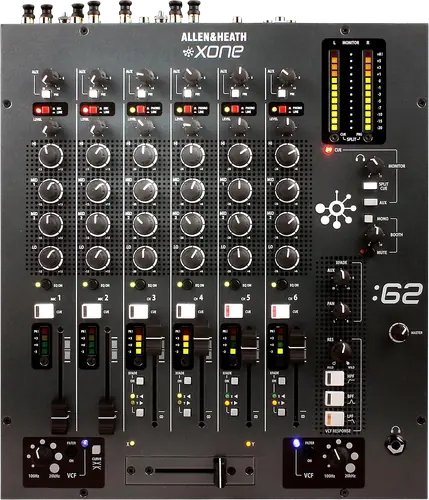
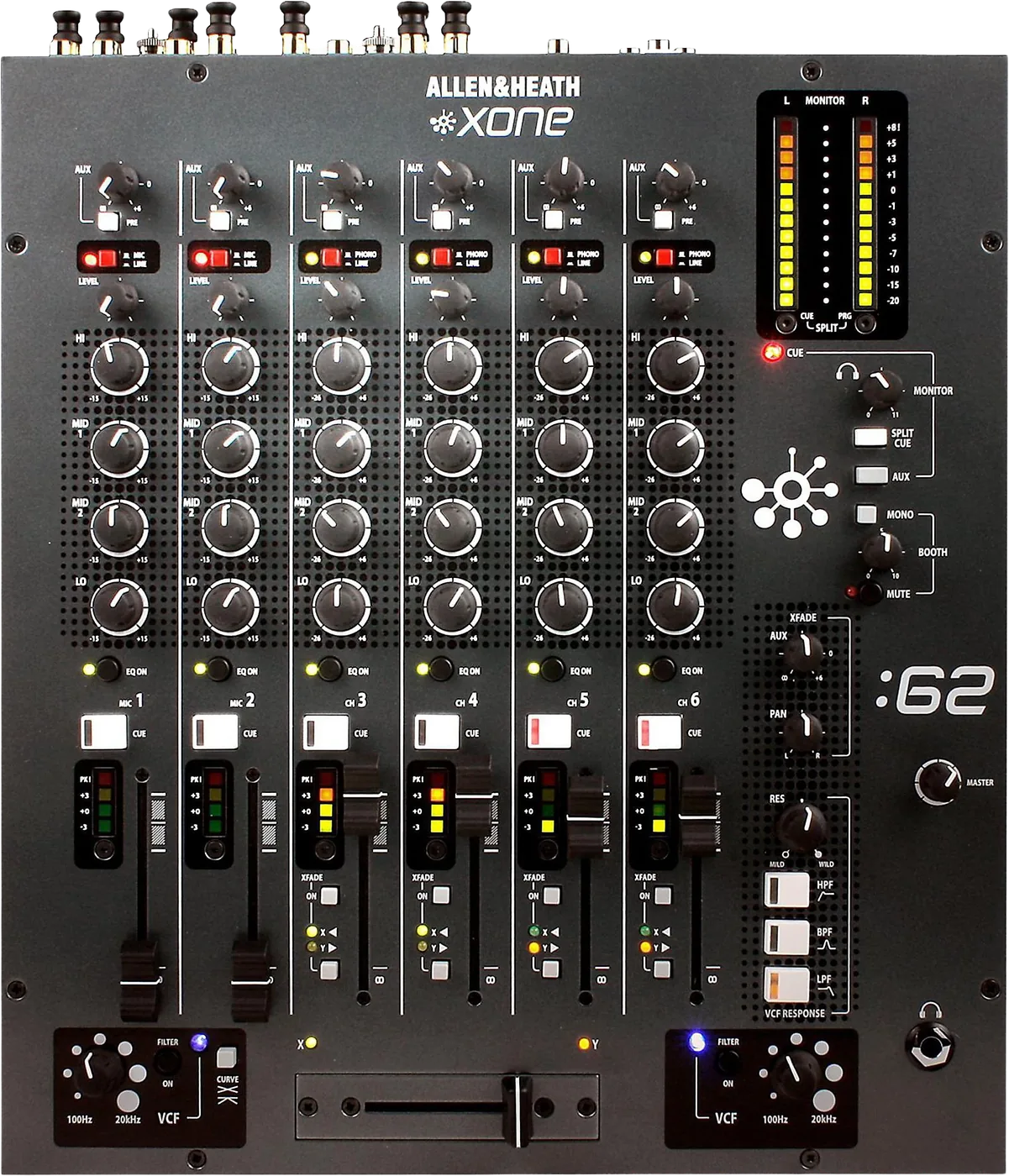
Booth briefing. The Xone:62 is a six channel all analogue club mixer with four band EQ on every channel and two stereo voltage controlled filters that Allen & Heath describe as a modern version of a classic analogue synth filter. There is no firmware, no USB and no MIDI, and there never was: there is nothing in it to run firmware on. The only version that matters is the hardware build, and you read that off the serial number before you order a part.
When it goes wrong: No sound from the mixer
Fast Lane
The five things that decide your gig
The five things on the Xone:62 that change what happens next, if you are reading this in the booth. All five are explained in full further down this page.
There is no firmware, and there never was.
There is no firmware for the Xone:62, and the reason is not that Allen & Heath stopped publishing it. There is nothing in the mixer to run firmware on. Its legacy resources page has no firmware section at all, not an empty one and not an archived one, and the user guide contains no firmware, no version number and no update procedure. The question every other page here opens with, what version is it on, has no meaning on this mixer.
Read the serial number before you order any spare part.
The only version that matters here is the hardware build, and you read it off the serial number. Version 1 has order code XONE:62/, serial numbers beginning 020000, a stainless steel panel, a 100 mm linear MIX master fader and an Alps crossfader. Version 2 has order code XONE2:62/, serials beginning 030000, a painted silver textured panel, a rotary MIX master control and a Penny & Giles crossfader. Allen & Heath say the circuit information is mostly identical between the two, with the differences noted on the relevant diagrams. That statement is about the circuits, not about the panel: the master control and the crossfader are genuinely different components between the builds.
You cannot run a high pass on one side and a low pass on the other.
Each side has its own sweep control and its own ON switch, and the filter type and the resonance are global. Allen & Heath print it: "The filter type and resonance effect are globally selected affecting both filters simultaneously." So you cannot run a high pass on X and a low pass on Y. That is a hard limit of this mixer and a real difference from the later Xones.
The filter going quiet is documented behaviour, not a fault.
Allen & Heath document the one behaviour that looks like a fault. Their troubleshooting entry covers a filter that leaves almost no sound, and the remedy they give is one sentence: "Operate the VCF frequency control to restore the frequency content of the sound." Engaging a filter with the sweep parked at an extreme is expected, not broken.
It is not a kill EQ and Allen and Heath never call it one.
This is not a kill EQ and Allen & Heath never call it one. Their word is "extended cut" and the printed figure on the music channels is plus 6 to minus 26 dB across four bands at 100 Hz, 250 Hz, 2.5 kHz and 10 kHz. Minus 26 dB is deep attenuation and it is not a mute. The microphone channels get a corrective plus or minus 15 dB on the same four frequencies.
If something goes wrong
Almost no sound when the filter comes on
Short answer. Allen & Heath document the one behaviour that looks like a fault. Their troubleshooting entry covers a filter that leaves almost no sound, and the remedy they give is one sentence: "Operate the VCF frequency control to restore the frequency content of the sound." Engaging a filter with the sweep parked at an extreme is expected, not broken.
Why it happens. Engage a filter on the Xone:62 with its sweep parked at an extreme and the channel goes almost silent the instant you press the button. Allen & Heath document the symptom and the cure and do not explain why, so neither does this page.
The habit that prevents it. Park the sweep in the middle before you switch a filter in, or learn where you left it. Allen & Heath put this in their troubleshooting section, which is where a maker puts something people ask about.
A crossfader that has gone stiff or sloppy
Short answer. Allen & Heath publish the whole crossfader job in the user guide, and the VCA design means a worn fader goes stiff or sloppy rather than crackly. The Version 2 part is XONE2:XFADER. Undo and remove the two OUTER screws on the crossfader plate with a medium Pozidriv, and do not remove the inner screws. Lift the assembly away, unplug the old cable, plug in the new one and check the connector is aligned and pushed home. Refit with the cable facing the LEFT side of the console, then test.
What you will not hear. Allen & Heath point out that the Xone:62 uses a VCA design, so a worn crossfader does not crackle the way a conventional audio fader does, because the fader is controlling a voltage rather than passing the audio. So the symptom is mechanical: stiffness or slop, not noise.
Order the right part. Which crossfader is in your mixer depends on the hardware build, so read the serial number first.
What to watch for
Why the firmware question does not apply here
Short answer. There is no firmware for the Xone:62, and the reason is not that Allen & Heath stopped publishing it. There is nothing in the mixer to run firmware on. Its legacy resources page has no firmware section at all, not an empty one and not an archived one, and the user guide contains no firmware, no version number and no update procedure. The question every other page here opens with, what version is it on, has no meaning on this mixer.
What is actually in it. No USB, no MIDI, no digital input and no digital output. The complete connector list is XLR, TRS, RCA, IEC and a headphone jack, and the block diagram shows no digital path. There is no soundcard, no DSP and no effects section: Allen & Heath’s own answer to wanting effects on this mixer is to plug an outboard unit into the aux send and return it to a spare channel. The VCA crossfader and the filters are voltage controlled analogue, not digital.
The history of the missing MIDI. The absence of MIDI has a well documented history. MIDI arrived on the later Xone:92 because of a custom Xone:62 built for a DJ by his father, which Allen & Heath have talked about themselves. The custom one was custom precisely because the production mixer did not do it.
What to do with that. Nothing about this mixer can be improved or broken by a download. If it works today it will work the same way in five years, and if it does not work the answer is a component rather than a version.
The EQ, and the word Allen and Heath use for it
Short answer. This is not a kill EQ and Allen & Heath never call it one. Their word is "extended cut" and the printed figure on the music channels is plus 6 to minus 26 dB across four bands at 100 Hz, 250 Hz, 2.5 kHz and 10 kHz. Minus 26 dB is deep attenuation and it is not a mute. The microphone channels get a corrective plus or minus 15 dB on the same four frequencies.
Why the distinction is worth a section. A DJ who learned on a mixer with true kill EQ builds routines around the bass disappearing completely, and the Xone:62 does not do that. Minus 26 dB is a very deep cut and it is not silence, so a transition built on a kill will not land the same way here.
And the microphone channels are different again. Channels 1 and 2 get a corrective plus or minus 15 dB rather than the deep cut, which is the right shape for a voice and the wrong shape for a breakdown.
Compatibility
The two hardware builds, and how to tell them apart
Short answer. The only version that matters here is the hardware build, and you read it off the serial number. Version 1 has order code XONE:62/, serial numbers beginning 020000, a stainless steel panel, a 100 mm linear MIX master fader and an Alps crossfader. Version 2 has order code XONE2:62/, serials beginning 030000, a painted silver textured panel, a rotary MIX master control and a Penny & Giles crossfader. Allen & Heath say the circuit information is mostly identical between the two, with the differences noted on the relevant diagrams. That statement is about the circuits, not about the panel: the master control and the crossfader are genuinely different components between the builds.
Why you check it first. Read the serial number before you order any part. The master level control alone is a different component between the two builds, a 100 mm fader on Version 1 and a rotary control on Version 2, and the crossfaders are from different makers.
What is the same, and what is not. Allen & Heath say the circuit information is mostly identical between the two, with the differences noted on the relevant diagrams. That is about the circuits, not the panel: the master control and the crossfader are genuinely different components.
What it will and will not connect to
There is no computer connection of any kind. No USB, no MIDI, no digital input and no digital output. The complete connector list is XLR, TRS, RCA, IEC and a headphone jack, and the block diagram shows no digital path. There is no soundcard, no DSP and no effects section: Allen & Heath’s own answer to wanting effects on this mixer is to plug an outboard unit into the aux send and return it to a spare channel. The VCA crossfader and the filters are voltage controlled analogue, not digital.
So DVS is not a question this mixer answers. No Allen & Heath source mentions timecode or DVS for the Xone:62 in either direction. This page does not claim it and does not deny it in their name.
Effects. There is no effects section and no DSP. Allen & Heath’s own answer is to put an outboard unit on the aux send and return it to a spare channel, which is what the aux output is there for.
Features explained
The filters, and the one limit people hit on stage
What they are. Two stereo state variable voltage controlled filters, one per side of the crossfader, on X and Y, operating independently. Allen & Heath describe them in their own brochure as "a stable, modern version of the filters you find on classic analogue synths". Three types by switch: high pass, band pass and low pass, and the guide documents combining them, HPF plus LPF gives a notch and all three together gives all pass. The sweep runs 100 Hz to 20 kHz, and the high pass is limited to 10 kHz at the top.
The limit, and it is a hard one. Each side has its own sweep control and its own ON switch, and the filter type and the resonance are global. Allen & Heath print it: "The filter type and resonance effect are globally selected affecting both filters simultaneously." So you cannot run a high pass on X and a low pass on Y. That is a hard limit of this mixer and a real difference from the later Xones.
Where they sit in the signal path. The filters sit on the crossfader X and Y buses rather than on individual channels. Only channels 3 to 6 can be filtered, and only after pressing XFADE ON and assigning the channel to X or Y. The microphone channels 1 and 2 cannot be filtered at all, and a channel routed direct to the mix bypasses the filters entirely.
And the behaviour that looks like a fault. Allen & Heath document the one behaviour that looks like a fault. Their troubleshooting entry covers a filter that leaves almost no sound, and the remedy they give is one sentence: "Operate the VCF frequency control to restore the frequency content of the sound." Engaging a filter with the sweep parked at an extreme is expected, not broken.
Professional tips
Before you play on one
Park the filter sweep before you engage it. Coming on with the sweep at an extreme takes the channel to almost nothing, and that is expected.
Plan for one filter type at a time. The type switch and the resonance are global, so both sides do the same thing.
Do not build a routine on a kill. The cut is deep and it is not a mute.
Photograph the serial number. You will need it the day a fader wears out, and it is on the mixer rather than in a menu.
Bring your own effects. The aux send and a spare channel is the whole effects architecture here, and it is a good one.
Connections and setup
What goes in and what comes out
Channels. It has six stereo channels, twelve inputs. Channels 1 and 2 switch between microphone and line, channels 3 to 6 between phono and line.
Inputs. balanced XLR microphone inputs on channels 1 and 2, unbalanced TRS line inputs on the same two, and RCA phono and RCA line inputs on channels 3 to 6, plus two turntable earth posts on the rear panel.
Outputs. a balanced XLR mix output at +4 dBu, an RCA record output, and impedance balanced TRS aux, mono and booth outputs, with a front panel stereo TRS headphone jack. Maximum output is +26 dBu from the XLRs.
Faders. 60 mm stereo channel faders and a 45 mm stereo VCA crossfader.
EQ. four bands on every channel at 100 Hz, 250 Hz, 2.5 kHz and 10 kHz. On the music channels 3 to 6 the range is plus 6 to minus 26 dB, and on the microphone channels 1 and 2 it is plus or minus 15 dB
Power. an IEC inlet at 100 to 240 V AC, 50 or 60 Hz, drawing 30 W at maximum, from an internal switch mode supply with auto sensing mains input. The mains fuse is rated T500mA, 20 mm.
The physical facts. It measures 320 x 358 x 105 mm as width, then depth, then height, and weighs 5.0 kg. Its audio performance is plus 0 to minus 1 dB from 20 Hz to 40 kHz, total harmonic distortion below 0.006 percent with noise at 1 kHz, channel shutoff crosstalk below 90 dB at 1 kHz, and plus 21 dB of headroom on the channels with plus 23 dB from mix to output.
Safety
Looking after one
The crossfader is the wear part and it is designed to be replaced. Allen & Heath publish the whole crossfader job in the user guide, and the VCA design means a worn fader goes stiff or sloppy rather than crackly. The Version 2 part is XONE2:XFADER. Undo and remove the two OUTER screws on the crossfader plate with a medium Pozidriv, and do not remove the inner screws. Lift the assembly away, unplug the old cable, plug in the new one and check the connector is aligned and pushed home. Refit with the cable facing the LEFT side of the console, then test.
The fuse is on the record. Allen & Heath print the mains fuse rating in the user guide, and it is worth knowing that it is a stated figure rather than something to guess at. Fitting the wrong one is not a repair.
What does not age on it. There is no memory to lose and no firmware to corrupt, which is a real advantage in a unit this old. Allen & Heath name the crossfader as the heavily used part and publish the procedure for it, and this page does not extend that to components they say nothing about.
Firmware, drivers and manuals
What Allen and Heath still publish
One download, and it is the right one. The legacy resources page for this mixer carries a documents archive and the licence text, and no more than that. There is no firmware section and no driver section, because neither exists for this product.
The documents that matter. The User Guide AP4145 carries the specification, the filter section and the crossfader replacement procedure. The Service Manual AP3842 carries the panel drawings, the block diagrams and the version differences, and it is the document that tells you which build you have.
Official downloads and documents
Go to Allen & Heath for the files themselves. We link their pages instead of hosting a copy, because a manual copied here is a snapshot of release day and theirs is the one that stays current.
Manuals. Official Allen & Heath manual page →
Broken link? Let us know and we'll fix it.
Frequently asked questions
Quick answers
- What firmware version should it be on?
- There is no firmware for the Xone:62, and the reason is not that Allen & Heath stopped publishing it. There is nothing in the mixer to run firmware on. Its legacy resources page has no firmware section at all, not an empty one and not an archived one, and the user guide contains no firmware, no version number and no update procedure. The question every other page here opens with, what version is it on, has no meaning on this mixer.
- Does it have USB or MIDI?
- No. No USB, no MIDI, no digital input and no digital output. The complete connector list is XLR, TRS, RCA, IEC and a headphone jack, and the block diagram shows no digital path. There is no soundcard, no DSP and no effects section: Allen & Heath’s own answer to wanting effects on this mixer is to plug an outboard unit into the aux send and return it to a spare channel. The VCA crossfader and the filters are voltage controlled analogue, not digital.
- Can I use it for DVS?
- No Allen and Heath source mentions timecode or DVS for this mixer in either direction, so this page neither claims it nor denies it in their name.
- How do I tell which version I have?
- The only version that matters here is the hardware build, and you read it off the serial number. Version 1 has order code XONE:62/, serial numbers beginning 020000, a stainless steel panel, a 100 mm linear MIX master fader and an Alps crossfader. Version 2 has order code XONE2:62/, serials beginning 030000, a painted silver textured panel, a rotary MIX master control and a Penny & Giles crossfader. Allen & Heath say the circuit information is mostly identical between the two, with the differences noted on the relevant diagrams. That statement is about the circuits, not about the panel: the master control and the crossfader are genuinely different components between the builds.
- Does it have kill EQ?
- This is not a kill EQ and Allen & Heath never call it one. Their word is "extended cut" and the printed figure on the music channels is plus 6 to minus 26 dB across four bands at 100 Hz, 250 Hz, 2.5 kHz and 10 kHz. Minus 26 dB is deep attenuation and it is not a mute. The microphone channels get a corrective plus or minus 15 dB on the same four frequencies.
- How many filters does it have?
- Two stereo state variable voltage controlled filters, one per side of the crossfader, on X and Y, operating independently. Allen & Heath describe them in their own brochure as "a stable, modern version of the filters you find on classic analogue synths". Three types by switch: high pass, band pass and low pass, and the guide documents combining them, HPF plus LPF gives a notch and all three together gives all pass. The sweep runs 100 Hz to 20 kHz, and the high pass is limited to 10 kHz at the top.
- Can I run a different filter type on each side?
- No. Each side has its own sweep control and its own ON switch, and the filter type and the resonance are global. Allen & Heath print it: "The filter type and resonance effect are globally selected affecting both filters simultaneously." So you cannot run a high pass on X and a low pass on Y. That is a hard limit of this mixer and a real difference from the later Xones.
- Which channels can be filtered?
- The filters sit on the crossfader X and Y buses rather than on individual channels. Only channels 3 to 6 can be filtered, and only after pressing XFADE ON and assigning the channel to X or Y. The microphone channels 1 and 2 cannot be filtered at all, and a channel routed direct to the mix bypasses the filters entirely.
- Does it have an LFO on the filters?
- No. The user guide names no LFO control, no LFO switch and no LFO anywhere in its filter section, and the brochure does not either. The Xone:92 is the mixer with LFOs and that does not carry back to this one.
- The filter makes it almost silent. Is it broken?
- Allen & Heath document the one behaviour that looks like a fault. Their troubleshooting entry covers a filter that leaves almost no sound, and the remedy they give is one sentence: "Operate the VCF frequency control to restore the frequency content of the sound." Engaging a filter with the sweep parked at an extreme is expected, not broken.
- How do I replace the crossfader on a Version 2?
- Allen & Heath publish the whole crossfader job in the user guide, and the VCA design means a worn fader goes stiff or sloppy rather than crackly. The Version 2 part is XONE2:XFADER. Undo and remove the two OUTER screws on the crossfader plate with a medium Pozidriv, and do not remove the inner screws. Lift the assembly away, unplug the old cable, plug in the new one and check the connector is aligned and pushed home. Refit with the cable facing the LEFT side of the console, then test. That is the Version 2 job. On a Version 1 the crossfader is a different make and this site has published no procedure for it, so read the serial number before you order anything.
- Does it have effects?
- No. There is no effects section and no DSP. Allen and Heath’s own answer is an outboard unit on the aux send, returned to a spare channel.
- When was it released?
- Allen & Heath have published no document dating this mixer, and it is the softest year on this site. What it rests on is Allen & Heath’s own David Morbey, quoted saying their first DJ mixer, the Xone:62, was produced in 1999, and their own service manual stating that the revised Version 2 replaced the original in October 2000. Those two together bracket the original to 1999 or 2000. Their earliest surviving guide for it is from 2001, so the company speaking through an interview is the best evidence there is.
- Is it discontinued?
- Discontinued, and documented by Allen & Heath’s own site structure rather than by a sentence: it lives under their legacy products path, it is absent from the current Xone range page, and no product page for it resolves.
Playing soon and it is not working?
Start Emergency ModeKeep the Emergency Card
We will email you the printable PDF so it is on your phone before the next dark booth. Occasional notes that save gigs. No spam, unsubscribe in one click.
Registering is free and counts everywhere on Save My Gig. We send a confirmation email first. Your address is stored with Brevo, our email provider. Unsubscribe any time. Privacy
Sources: Allen and Heath's own User Guide AP4145 Issue 5, Service Manual AP3842, the crossfader fitting note AP7170, the product brochure and their legacy resources page, checked 10 September 2026. Specifications theirs, priorities ours.