

WARM2, the field manual
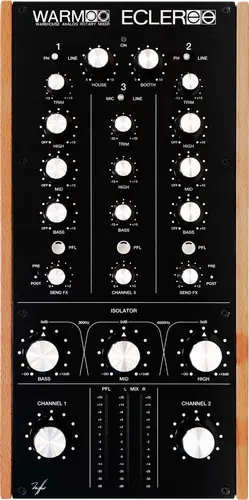
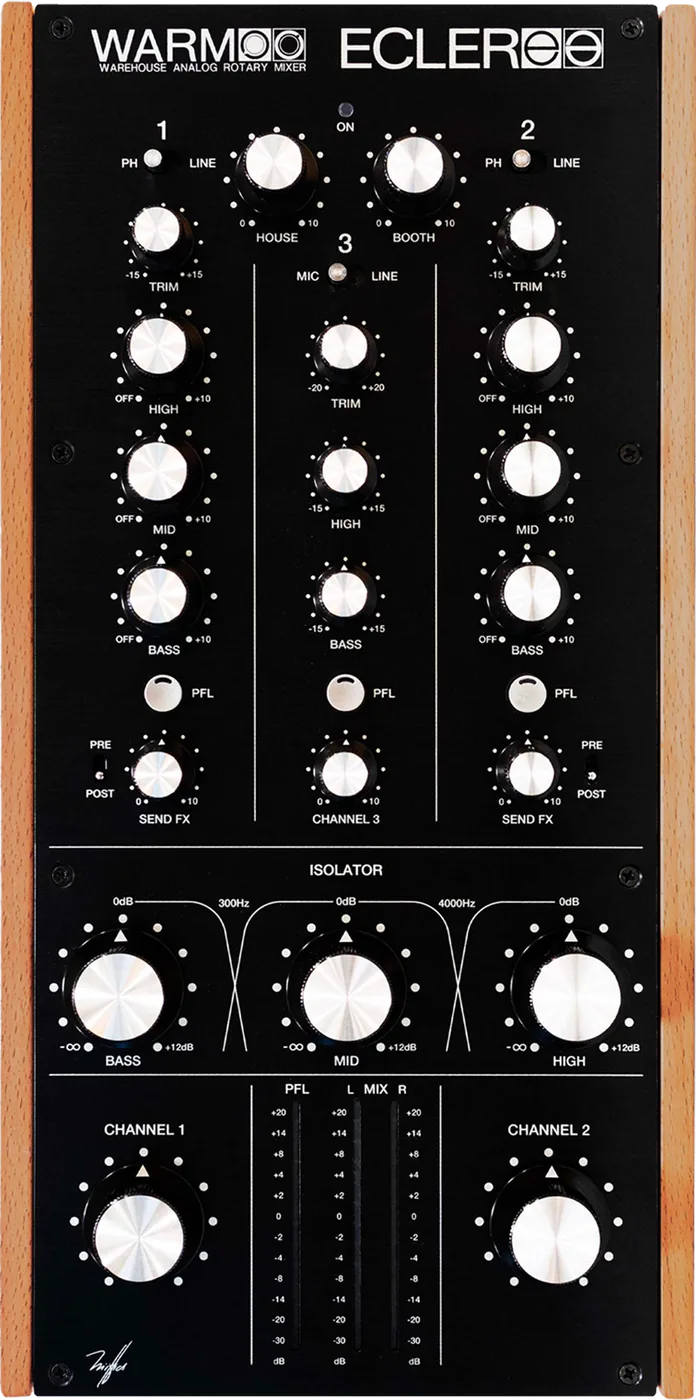
Booth briefing. The WARM2 is Ecler's two channel analogue rotary mixer, built in Barcelona, and analogue here means the electronics as well as the knobs: no converters, no USB, no firmware. There is no crossfader. The channel EQ cuts deeply and so does the isolator, and neither is a kill: the manual gives the channel tone as +10/-30 dB and the isolator as +12/-70 dB at the ends. The isolator sits on the master and not on the channels, so a DJ meets two different deep cut controls doing two different jobs. Phantom power and the output level are set inside the case, and the setup section covers both.
When it goes wrong: No sound from the mixer
Fast Lane
The five things that decide your gig
The five things on the WARM2 that change what happens next, if you are reading this in the booth. All five are explained in full further down this page.
There is no crossfader, and nothing on the panel replaces one.
Ecler document none anywhere in the manual or the datasheet, and the control list runs from the input selector to the headphone volume without one.
If your set depends on cuts, this is the wrong desk for it, and that has to be planned around before you are standing behind it.
The isolator is on the master. The channel EQ is a different deep cut control.
Ecler: "In addition to the channel EQ, a powerful 3-way Isolator is available on the main output. It provides a +12/-70dB boost/cut at high and low frequencies and +12/-40 dB at the mid-range."
So killing the bass on one deck is the channel EQ, and killing it across the whole mix is the isolator. Reaching for the wrong one costs you the transition.
Phantom power is ON when the mixer arrives.
Ecler: "The WARM2 includes 18V Phantom power for condenser microphones. An internal jumper allows disabling the phantom power. The WARM2 MICRO input is delivered with enabled phantom power by default."
A ribbon microphone plugged into a live phantom input can be damaged by it. Check before you plug anything into the third channel that is not a dynamic mic.
Too quiet into the house system is usually a switch inside the mixer.
Ecler: "The nominal level of HOUSE output is set to 0dBV (1Vrms) by default, but it can be set to +12dBV (4Vrms) using an internal dip-switch."
The booth output carries the same internal dip-switch and the same default, so a WARM2 that sounds too quiet into a house system is often a mixer still set to its 0 dBV default rather than a fault.
The effects loop is on RCA, so bring adapters.
The FX SEND output and FX RETURN input are on RCA, with a send level per channel and a PRE/POST fader switch, and a nominal level of 0 dBV on both.
The loop is RCA rather than 6.3 mm TRS, so an effects unit with jack connections needs adapters.
What to watch for
There is no firmware, and that is good news
This mixer has no firmware and no USB connection. The signal path is analogue throughout, so there is nothing to update and no driver to install.
A whole class of booth failure cannot happen on a WARM2. There is no update to be behind on, no version that stops talking to a player, and no boot into a broken state after a power cut.
If you are hunting for Ecler support and finding none
Ecler publish no DJ knowledge base and no FAQ for the WARM series. Their help centre carries around thirty product categories and every one of them is a commercial install product: no mixer, no rotary, no DJ category at all.
Neither the WARM2 nor the WARM4 manual contains a troubleshooting section. Between them the published guidance for a mixer that has stopped working is a fuse rating and a cleaning instruction.
The routes Ecler do publish are a technical request form, an email address and a phone line, all of them aimed at the install catalogue.
It sounds too quiet into the house system
Short answer. The Ecler WARM2 leaves the factory on the lower of two nominal output levels, and the higher one is a switch inside the case rather than a control on the panel. The nominal level of HOUSE output is set to 0dBV (1Vrms) by default, but it can be set to +12dBV (4Vrms) using an internal dip-switch. The booth output carries the same internal dip-switch and the same default, so a WARM2 that sounds too quiet into a house system is often a mixer still set to its 0 dBV default rather than a fault.
Why it presents as a fault. Nothing on the front panel states which of the two levels the mixer is on. So the desk reads as fully open, the meters read as sensible, and the house still sounds short of level. The gain you are hunting is behind the lid, and Ecler document it in a configuration diagram at the back of the manual rather than anywhere you would look during a set.
What to do in the room. Nothing inside the mixer. On a desk that is not yours, this is answered at the house system's own input gain, and the person to tell is whoever looks after the install. The switch is a permanent decision about how the mixer is wired into a room, not a per gig control.
The other setting behind the same lid. The WARM2 includes 18V Phantom power for condenser microphones. An internal jumper allows disabling the phantom power. The WARM2 MICRO input is delivered with enabled phantom power by default. So the mic input arrives live from the factory and turning it off is an internal jumper, which is worth knowing before a microphone you did not choose is plugged into a desk you did not set up.
Features explained
No crossfader, and what the panel gives you instead
Neither mixer has a crossfader. It is not fitted, not optional and not removable, and neither manual documents one anywhere.
2+1 mixing channels: two phono/line channels and a third switchable between microphone and line. Each channel has an input selector, a trim, three bands of tone control, a headphone cue, an effects send with its own pre or post switch, and a rotary level. That is the whole strip.
Ecler describe it as a professional two channels analogue rotary DJ mixer, designed and manufactured by ECLER in Barcelona, and say all circuits are strictly designed, mounted and tested at Ecler facilities in Barcelona.
Neither manual describes a split cue. On both mixers, monitoring is a blend between the selected PFL and the main mix on one SOURCE control.
The isolator, and the channel EQ that is not it
Ecler put it plainly: In addition to the channel EQ, a powerful 3-way Isolator is available on the main output. It provides a +12/-70dB boost/cut at high and low frequencies and +12/-40 dB at the mid-range.
3 bands, 4th order at 24 dB per octave, with cut frequencies at -6 dB of 300 Hz, 300 Hz to 4 kHz, and 4 kHz.
The channel tone controls are the other deep cut on this mixer, and they move different frequencies. The channel tone controls cut at -6 dB with a 12 dB per octave slope: bass at 200 Hz, mid from 200 Hz to 6.8 kHz, and treble at 6.8 kHz.
The WARM2 has no isolator bypass button. The WARM4 added one.
How far the tone controls actually go, and why we print two answers
The User Manual gives the channel tone ranges as bass +10/-30 dB, mid +10/-25 dB and treble +10/-30 dB on channels 1 and 2, with the microphone and line channel at plus or minus 15 dB on both bass and treble.
The Data Sheet gives different figures for the same controls: bass plus or minus 15 dB and mid plus or minus 20 dB on channels 1 and 2, and treble +10/-25 dB on the third channel.
Ecler publish two figures for the same controls and this site prints both rather than choosing. The Data Sheet also disagrees with itself on the isolator, listing minus infinity over +12 dB in its feature summary and plus or minus 15 dB for treble in its specification table.
On the WARM2, Ecler’s user manual and its data sheet print different tone control ranges for the same controls, in five places, and the data sheet disagrees with itself on the isolator. The Spanish edition of the manual matches the English manual on every one of those five points, so the data sheet is the document out of step. This site prints both readings and picks neither, because two agreeing documents are stronger evidence than one and still not a measurement of the hardware.
At least three revisions of the WARM2 manual are in circulation, so two owners can be reading different numbers from documents that carry the same name. In order of age they are the edition stamped v.20211222, then 50-0421-0100, then 50-0421-0102.
The two settings sealed inside the case
Both of these read as faults from the front panel, and neither is one. The louder of the two has its own section: it sounds too quiet into the house system. Ecler document both only in a configuration diagram at the back of the manual.
The nominal level of HOUSE output is set to 0dBV (1Vrms) by default, but it can be set to +12dBV (4Vrms) using an internal dip-switch. The booth output carries the same internal dip-switch and the same default, so a WARM2 that sounds too quiet into a house system is often a mixer still set to its 0 dBV default rather than a fault.
The WARM2 includes 18V Phantom power for condenser microphones. An internal jumper allows disabling the phantom power. The WARM2 MICRO input is delivered with enabled phantom power by default.
Low impedance monophonic microphones between 200 and 600 ohms.
The effects loop
The FX SEND output and FX RETURN input are on RCA, with a send level per channel and a PRE/POST fader switch, and a nominal level of 0 dBV on both.
The loop is RCA rather than 6.3 mm TRS, so an effects unit with jack connections needs adapters.
Connections and setup
What goes in
What comes out, and the one that is unbalanced
HOUSE on balanced XLR and on unbalanced RCA, BOOTH on unbalanced RCA only, and a REC output on RCA.
The booth being unbalanced RCA is worth knowing before a long monitor run, because an unbalanced cable picks up more of whatever else is in the booth. The WARM4 adds a balanced booth output on XLR and this model does not have one.
21 dBV, which Ecler also print as 23 dBu, on the balanced house, unbalanced house and booth outputs.
A 6.3 mm and a 3.5 mm stereo jack on the front panel, with a SOURCE control blending the selected PFL against the main mix and a separate volume. Ecler recommend high impedance headphones between 200 and 600 ohms.
One 12-segment LED VU meter, switchable between the mix and PFL, running from -30 dBV to +20 dBV.
Power, and the fuse
The WARM2 runs from an internal universal supply, so it needs no voltage selector anywhere in the world. A universal internal supply running 90 to 264 V at 47 to 63 Hz with no internal modification, rated at 30 VA.
T 0.5 A. Ecler are explicit about what to do if it goes again: if the new fuse blows a second time, stop and contact their authorised technical service, and never short the security path or fit a higher value.
Frequently asked questions
How big is it, and will it fit between two decks?
400 x 185 x 100 mm, which Ecler state is without the wooden sides. 3.6 kg without them.
Ecler print the three figures without saying which is width, height or depth. The mechanical diagram gives 399.1 mm, 185 mm and 100 mm.
What comes in the box?
Is it really analogue, or just rotary?
Really analogue. Rotary describes the controls and it is often the only thing a rotary mixer has in common with another one: some are digital inside and are constantly mistaken for analogue desks.
Neither mixer has any digital audio in it. No USB, no converters, no DSP and no firmware, so there is no version to be behind on and no driver to install.
Ecler put their own experience at over 50 years of professional analogue audio design, and the WARM series is built on it rather than on a DJ back catalogue.
Commonly paired with
What you usually find beside it in working booths, from club, festival and rental installs rather than from a manufacturer document.
Playing soon and it is not working?
Emergency Mode walks you through the checks in order, and it works with no signal once you have opened it.
Start Emergency ModeKeep the Emergency Card
We will email you the printable PDF so it is on your phone before the next dark booth. Occasional notes that save gigs. No spam, unsubscribe in one click.
Registering is free and counts everywhere on Save My Gig. We send a confirmation email first. Your address is stored with Brevo, our email provider. Unsubscribe any time. Privacy