

WARM4, the field manual
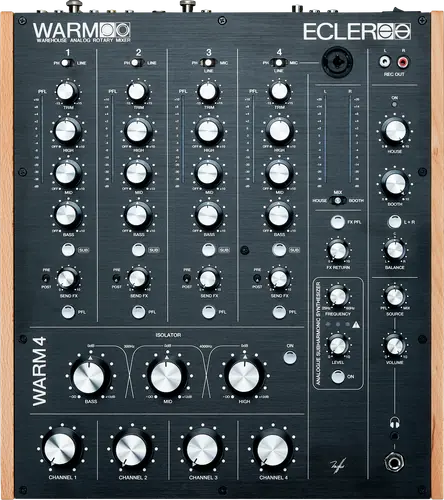
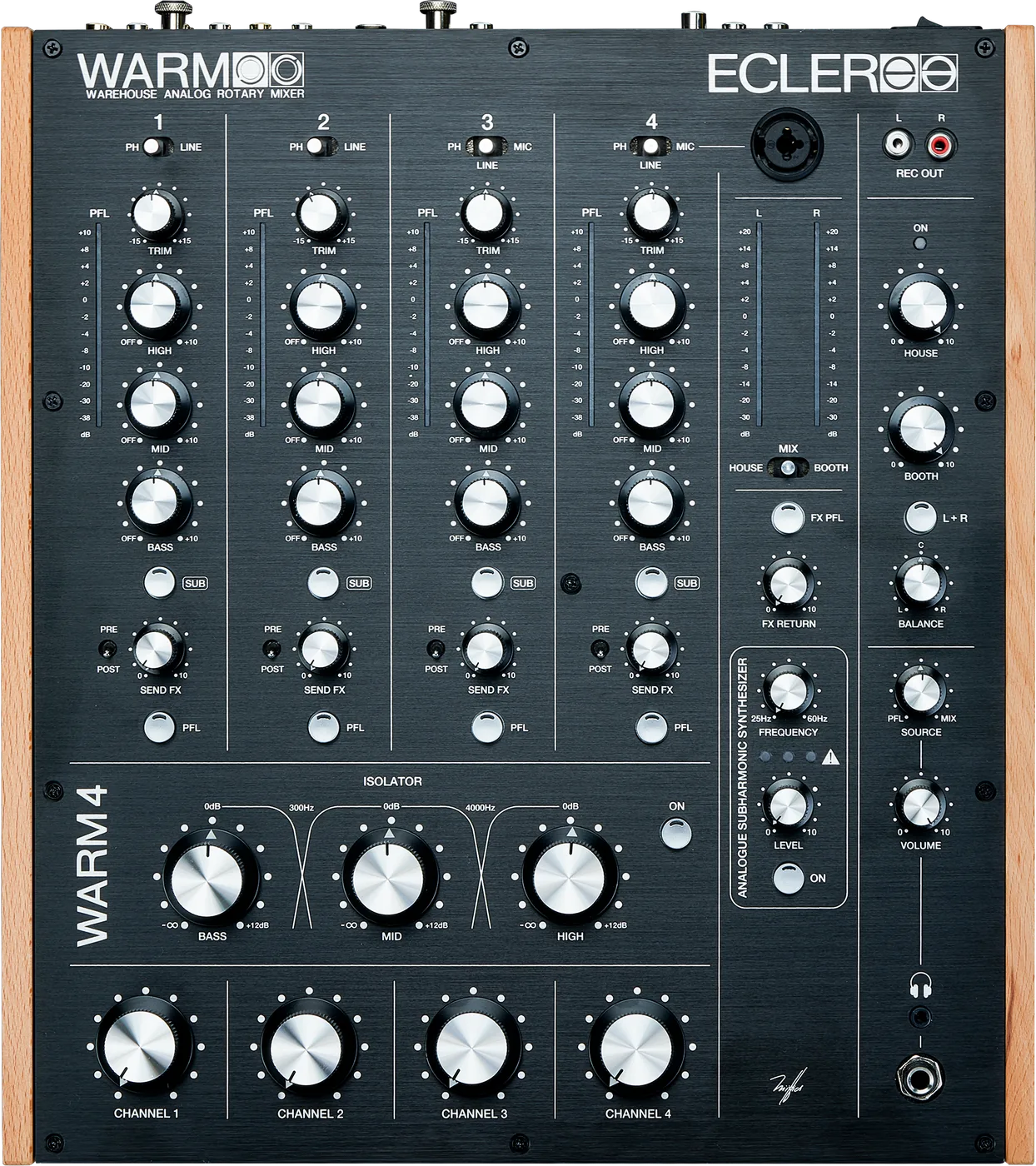
Booth briefing. The WARM4 is Ecler's four channel analogue rotary mixer, and analogue means the electronics as well as the knobs: no converters, no USB and no firmware, so nothing on it is ever out of date. There is no crossfader; the mix is done on the rotary channel controls. Its defining feature is a subharmonic synthesizer that generates bass below what is on the record, and it also carries an isolator. Ecler's manual sets out how the two are meant to be used together, and the sections below cover that.
When it goes wrong: No sound from the mixer
Fast Lane
The five things that decide your gig
The five things on the WARM4 that change what happens next, if you are reading this in the booth. All five are explained in full further down this page.
The subharmonic synthesizer can damage speakers, and Ecler say so.
Ecler: "Make use of the Analogue Subharmonic Synthesizer with extreme care and always check the Subharmonic VU-meter level before activating the ON button. By over-boosting the low frequency range, you might induce an excessive displacement of the loudspeakers membrane. The combined use of the Isolator and the Subharmonic Synthesizer functions, if not done properly, can result in damage to the loudspeakers."
Check the subharmonic meter before you engage it, not after. The house rig is not yours.
Ecler tell you not to use the isolator live.
Ecler: "Since WARM4 is a completely analogue device, in the presence of a musical signal and when switching the Isolator on and off, clicking sounds may occur, this being the reason NOT to use it in live performances."
That is a manufacturer ruling out its own headline control during a performance, which is rare enough to be worth reading twice. The bypass is a real relay, and relays click.
The two microphone inputs take different connectors.
Two microphone inputs on different connectors. Channel 3 takes a female XLR3 only, on the rear. Channel 4 takes a combo female XLR3 and balanced 6.3 mm TRS, on the front panel.
So a jack that fits channel 4 will not fit channel 3, and nothing is broken. This is the likeliest "why will my cable not go in" on the mixer.
Too quiet into the house is a switch inside the case.
Ecler print it as "The nominal level of HOUSE output is set to 0dBV (1Vrms) by default, but it can be set to +12dBV (4Vrms) by using an internal DIP switch." The booth output carries the same switch and the same default.
Reaching that switch means opening the mixer: Ecler instruct you to remove the right wooden panel and follow the configuration diagram.
Phantom power is ON when the mixer arrives.
Ecler: "The WARM4 includes 18V phantom power for condenser microphones. An internal jumper allows disabling the phantom power. The WARM4 MICRO inputs are delivered with enabled phantom power by default."
A ribbon microphone plugged into a live phantom input can be damaged by it. Check before anything but a dynamic mic goes into channel 3 or channel 4.
What to watch for
There is no firmware, and that is good news
This mixer has no firmware and no USB connection. The signal path is analogue throughout, so there is nothing to update and no driver to install.
A whole class of booth failure cannot happen on a WARM4. There is no update to be behind on, no version that stops talking to a player, and no boot into a broken state after a power cut.
If you are hunting for Ecler support and finding none
Ecler publish no DJ knowledge base and no FAQ for the WARM series. Their help centre carries around thirty product categories and every one of them is a commercial install product: no mixer, no rotary, no DJ category at all.
Neither the WARM2 nor the WARM4 manual contains a troubleshooting section. Between them the published guidance for a mixer that has stopped working is a fuse rating and a cleaning instruction.
The routes Ecler do publish are a technical request form, an email address and a phone line, all of them aimed at the install catalogue.
It sounds too quiet into the house system
Short answer. The Ecler WARM4 leaves the factory on the lower of two nominal output levels, and the higher one is a switch inside the case rather than a control on the panel. Ecler print it as "The nominal level of HOUSE output is set to 0dBV (1Vrms) by default, but it can be set to +12dBV (4Vrms) by using an internal DIP switch." The booth output carries the same switch and the same default. Reaching that switch means opening the mixer: Ecler instruct you to remove the right wooden panel and follow the configuration diagram.
Why it presents as a fault. Nothing on the front panel states which of the two levels the mixer is on. So the desk reads as fully open, the meters read as sensible, and the house still sounds short of level. The gain you are hunting is behind the lid, and Ecler document it in a configuration diagram at the back of the manual rather than anywhere you would look during a set.
What to do in the room. Nothing inside the mixer. On a desk that is not yours, this is answered at the house system's own input gain, and the person to tell is whoever looks after the install. The switch is a permanent decision about how the mixer is wired into a room, not a per gig control.
The other setting behind the same lid. The WARM4 includes 18V phantom power for condenser microphones. An internal jumper allows disabling the phantom power. The WARM4 MICRO inputs are delivered with enabled phantom power by default. So the mic input arrives live from the factory and turning it off is an internal jumper, which is worth knowing before a microphone you did not choose is plugged into a desk you did not set up.
Features explained
The subharmonic synthesizer, and the warning that comes with it
An analogue subharmonic synthesizer, selectable per channel, designed to generate and reinforce ultra-low frequencies. Ecler claim it as unique in a DJ mixer, and it is the reason to choose this desk over the WARM2 for anything other than channel count.
Ecler are specific that this is not a filter: the Analogue Subharmonic Synthesizer generates sound waves at half the frequency of fundamentals, which oscillate between 120Hz and 50Hz, in a fairly selective way, generating copies in the range of 60Hz-25Hz.
An input selective filter from 50 to 120 Hz, harmonics synthesised from 25 to 60 Hz, and a maximum output level of +12 dBV.
A three-LED meter reads the subharmonic bus on its own: green for an average of -18 dBV as a signal-present indicator, yellow at 0 dBV, and red beginning to blink at an average of +4 dBV.
Ecler's warning, in full: Make use of the Analogue Subharmonic Synthesizer with extreme care and always check the Subharmonic VU-meter level before activating the ON button. By over-boosting the low frequency range, you might induce an excessive displacement of the loudspeakers membrane. The combined use of the Isolator and the Subharmonic Synthesizer functions, if not done properly, can result in damage to the loudspeakers.
Ecler also rule out small monitors outright: do not use the Subharmonic Synthesizer feature with small near-field studio monitors that cannot reproduce frequencies from 25 to 60Hz.
Ecler warn that on modern recordings the effect may be imperceptible or even annoying, because the mastering of each track is unique and the result differs on every track.
The mixer carries a high-pass anti-rumble filter at 20 Hz, which Ecler say ensures the mitigation of resonance coupling problems with turntable needles.
The isolator Ecler tell you not to use live
In addition to the channel EQ, a powerful 3-way Isolator is available on the main output. It provides a +12/-70dB boost/cut at high and low frequencies, and +12/-40 dB at mid range.
3 bands, 4th order at 24 dB per octave, with cut frequencies at -6 dB of 300 Hz, 300 Hz to 4 kHz, and 4 kHz.
Ecler's own instruction: Since WARM4 is a completely analogue device, in the presence of a musical signal and when switching the Isolator on and off, clicking sounds may occur, this being the reason NOT to use it in live performances.
The by-pass of this function is an actual relaying device, and it is not intended for its usage in live performances. Being a true by-pass, the signal does not pass through the isolator filters, so there is a lesser degree of phase distortion, resulting in a more faithful sound.
The channel tone controls are a separate deep cut, and they move different frequencies. The channel tone controls cut at -6 dB with a 12 dB per octave slope: bass at 200 Hz, mid from 200 Hz to 6.8 kHz, and treble at 6.8 kHz.
Bass +10/-30 dB, mid +10/-25 dB and treble +10/-30 dB on all four channels, with the manual and the datasheet in agreement.
No crossfader, and what the panel gives you instead
Neither mixer has a crossfader. It is not fitted, not optional and not removable, and neither manual documents one anywhere.
Ecler describe it as a professional four channel analogue rotary DJ mixer, designed and manufactured by ECLER in Barcelona, with four phono/line channels, two microphone inputs, classic sharp filters and a 4th-order isolator.
Ecler anchor the mixer to one room and one name: it is inspired by New York’s Paradise Garage’s sound, the club described by François Kevorkian as the "temple of music."
Neither manual describes a split cue. On both mixers, monitoring is a blend between the selected PFL and the main mix on one SOURCE control.
The two settings sealed inside the case
Both of these read as faults from the front panel, and neither is one. The louder of the two has its own section: it sounds too quiet into the house system.
Ecler print it as "The nominal level of HOUSE output is set to 0dBV (1Vrms) by default, but it can be set to +12dBV (4Vrms) by using an internal DIP switch." The booth output carries the same switch and the same default.
Reaching that switch means opening the mixer: Ecler instruct you to remove the right wooden panel and follow the configuration diagram.
The WARM4 includes 18V phantom power for condenser microphones. An internal jumper allows disabling the phantom power. The WARM4 MICRO inputs are delivered with enabled phantom power by default.
Two microphone inputs, two different connectors
Two microphone inputs on different connectors. Channel 3 takes a female XLR3 only, on the rear. Channel 4 takes a combo female XLR3 and balanced 6.3 mm TRS, on the front panel.
Low impedance monophonic microphones between 200 and 600 ohms. For unbalanced microphones Ecler recommend monophonic jack plugs, though stereo ones work if the ring is shorted to the sleeve.
Connections and setup
What goes in
Four line inputs on RCA at 0 dBV into 50 kOhm, four phono inputs on RCA at -40 dBV into 50 kOhm across two ground pins, two balanced microphone inputs at -50 dBV, and an FX return on RCA.
What comes out, and the booth section
HOUSE on balanced XLR3 and unbalanced RCA, BOOTH on balanced XLR3 and unbalanced RCA, an unbalanced REC output, and an FX send on RCA.
The booth has its own level, an L+R mono button and a balance PAN control. The balanced booth on XLR is the install-facing difference between this mixer and the WARM2, which has an unbalanced booth only.
21 dBV, which Ecler also print as 23 dBu, on the balanced and unbalanced house and booth outputs.
A 6.3 mm and a 3.5 mm stereo jack on the lower right of the faceplate, with a SOURCE control blending the selected PFL against the main mix and a separate volume. Ecler recommend high impedance headphones between 200 and 600 ohms.
A 12-segment input meter on each of the four channels running from -38 dBV to +10 dBV, a 12-segment meter for the house, mix or booth from -30 dBV to +20 dBV with a source switch, and the separate three-LED subharmonic meter.
The effects loop
Power, the fuse and the room
The WARM4 runs from an internal universal supply, so it needs no voltage selector anywhere in the world. A universal internal supply running 90 to 264 V at 47 to 63 Hz, rated at 39 VA, through a 15 A IEC inlet.
T 0.5 A. Ecler are explicit about what to do if it goes again: if the new fuse also blows up, contact their authorised technical service immediately, and never short the security path or fit a higher value.
Rated for operation from -5 to 45 degrees Celsius at 20 to 90 percent relative humidity, without condensation.
Frequently asked questions
Can it be rack mounted?
Ecler list the installation options as desktop or rack mount with optional accessories, and do not name the accessories anywhere in the manual or the datasheet.
340 x 81 x 372 mm, which Ecler label as width by height by depth. 5.32 kg
What comes in the box?
What does this have that the WARM2 does not?
Four channels instead of two, the subharmonic synthesizer, a second microphone input, a balanced booth output on XLR with a mono button and a pan, an isolator bypass button, an effects return with its own monitoring and cue, and a meter on every channel rather than one shared meter.
It is also the model whose documents agree with each other. On the WARM2, Ecler’s user manual and its data sheet print different tone control ranges for the same controls, in five places, and the data sheet disagrees with itself on the isolator. The Spanish edition of the manual matches the English manual on every one of those five points, so the data sheet is the document out of step. This site prints both readings and picks neither, because two agreeing documents are stronger evidence than one and still not a measurement of the hardware.
Commonly paired with
What you usually find beside it in working booths, from club, festival and rental installs rather than from a manufacturer document.
Playing soon and it is not working?
Emergency Mode walks you through the checks in order, and it works with no signal once you have opened it.
Start Emergency ModeKeep the Emergency Card
We will email you the printable PDF so it is on your phone before the next dark booth. Occasional notes that save gigs. No spam, unsubscribe in one click.
Registering is free and counts everywhere on Save My Gig. We send a confirmation email first. Your address is stored with Brevo, our email provider. Unsubscribe any time. Privacy