

RP-7, the field manual
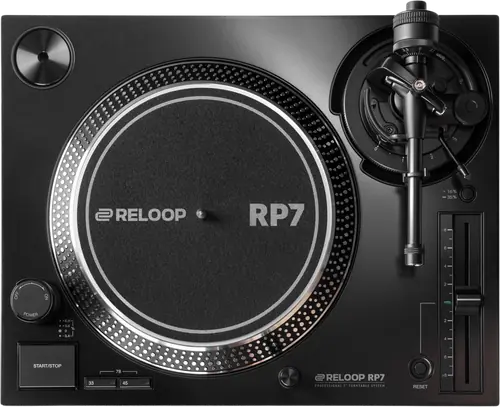
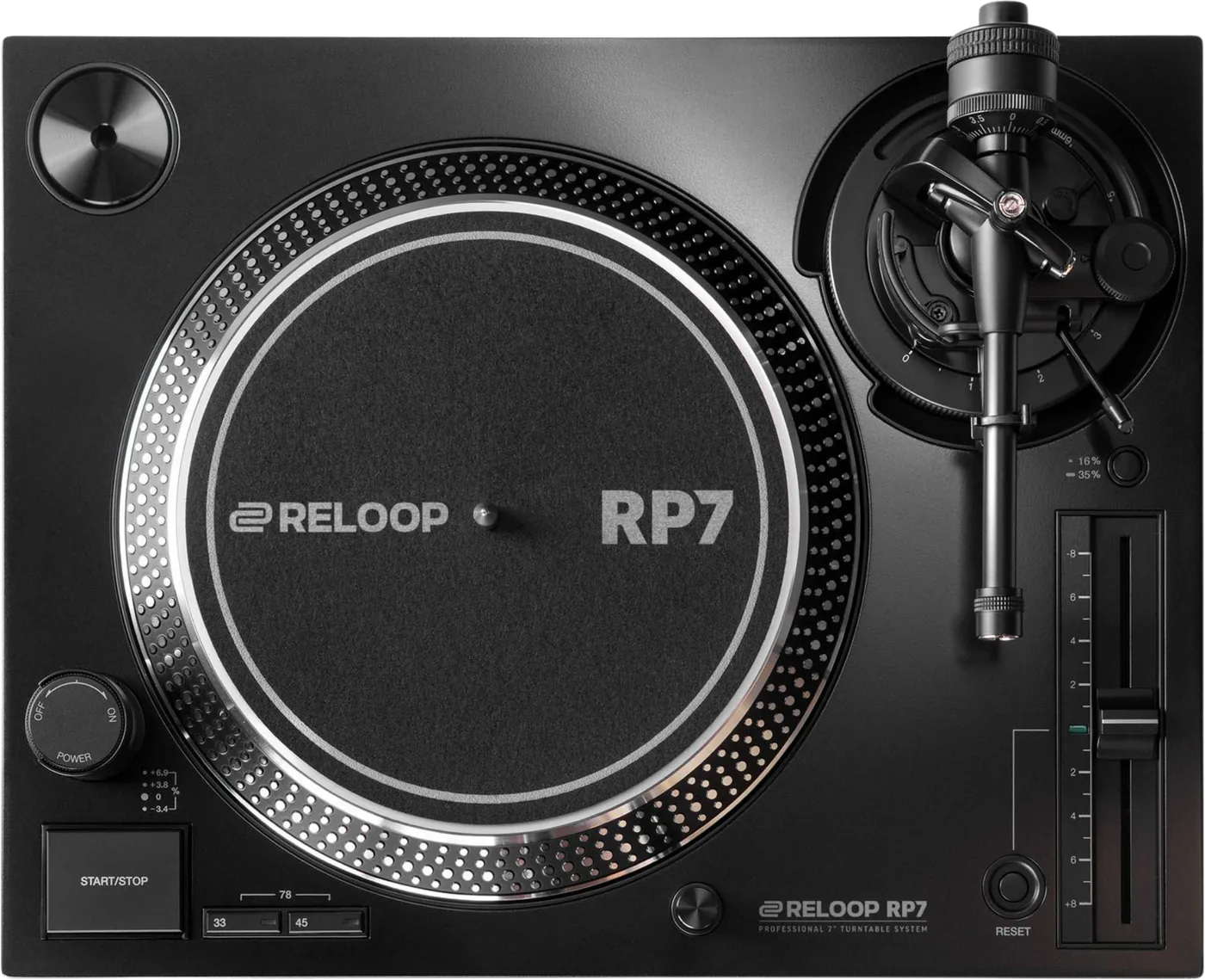
Booth briefing. The RP-7 is a 7 inch direct drive deck with a real tone arm behind it: 0 mm overhang, a 9.5 degree offset, and a published tracking angle table showing what that buys you across the record. Two things behave differently from the bigger decks while you are playing. Its output stage is active, so cutting the power stops the sound instantly and mid record, with no coasting. And the extended pitch range is a press and hold rather than a chord, ending at 35 percent rather than 50. Setting one up for the first time is a separate job, and the tone arm section covers what does not carry over.
When it goes wrong: A turntable that hums
Fast Lane
The five things that decide your gig
The five things on the RP-7 that change what happens next, if you are reading this in the booth. All five are explained in full further down this page.
Switch the deck off and the audio stops at once. The preamp needs power.
The RP-7 has an internal phono preamp and a phono/line switch, and Reloop state that the preamp needs constant power to output sound: switching the deck off kills the audio immediately. On a passive turntable the platter coasts and the cartridge keeps generating signal. This one goes silent at once, mid record.
That changes how you get off a record. On a passive deck you can cut the power and still ride the last bars out of a coasting platter, and that habit ends here. The fader is the only graceful way out.
There is no anti-skating control on this deck, and it is left off on purpose.
The RP-7 has no anti-skating control. It is absent from the parts list, from the operation section and from the specifications, and the word does not appear in any language section of the manual. Reloop state the reason on the product page instead: the statically balanced RP-7 system eliminates the need for anti-skating, which they say simplifies installation and reduces potential margins for error. The dial is missing by design, and only the manual leaves that unsaid.
The manual in the box does not tell you to stop looking, so a control that was never fitted reads as a control that has gone missing. Set the tracking force, check the arm height, and move on.
The counterweight scale faces the tone arm here and the DJ on both siblings.
The counterweight scale must face the TONE ARM TUBE on this deck. On the RP-7000 MK2 and RP-8000 MK2 Reloop require the same scale to face the DJ. Fitting it the way you fit the bigger decks puts the scale where it cannot be read, or gives a plausible and wrong number.
Fit it from muscle memory and the scale ends up either unreadable or giving a plausible number that is not the one you set. Look at which way the printing points before you trust any figure it gives you.
The wide pitch range is a press and hold, and it stops at 35 percent.
Plus or minus 8, 16 and 35 percent. The 8 and 16 percent ranges alternate on a press of the pitch range selector; the 35 percent range is reached by pressing and HOLDING the same button, and its LED flashes. A further press returns to 8 percent.
Its two larger siblings use a two button chord for an extended range, and their extended range is 50 percent rather than 35. Three Reloop decks, three gestures, two different extended ranges.
Standby arrives after 20 minutes, and a flash count is the only feedback.
The deck enters standby after 20 minutes of inactivity, indicated only by the pitch reset LED flashing slowly, and any control cancels it. Standby can be turned on or off permanently by holding START/STOP and the 33 RPM button while switching the deck on.
The only confirmation of which way standby was toggled is a flash pattern: both speed buttons flash twice slowly when going from on to off, and five times when going from off to on. Miscount and the only way to find out is to wait 20 minutes.
If something goes wrong
Out of a cold van into a warm room
Unpack the RP-7 first when you load in, before the mixer and before the cables, so that the wait Reloop require is running while you do everything else.
All five manuals forbid operating the unit after bringing it from a cold environment into a warm one, and require waiting until it reaches ambient temperature. None of the five states how long that takes, which is the one number a DJ loading in from a cold van actually needs.
What to watch for
A Spanish warning about a voltage this deck does not use
Nothing about the RP-7 itself changes here; what changes is how much weight a reader should give the Spanish safety text on this document, and the answer is to take the mains figures from the specification table and the back cover, which agree with each other.
The Spanish shock warning names a mains voltage this deck does not use, warning about 115 V at 60 Hz or 230 V at 50 Hz, where the specification table and the back cover both say AC 100 to 240 V. The figure appears carried over from the larger decks.
Nothing to update, which is a feature
The RP-7 having no firmware reads like a gap that would be a criticism, and it is not one. A deck with no firmware cannot arrive on a version that behaves differently from the one you rehearsed on, cannot be bricked by an interrupted update, and cannot need a computer before it will play a record. That removes an entire category of booth failure from the risk list.
The RP-7000 MK2 has no firmware, no USB port and no MIDI. The manual carries no firmware section, no update procedure and no version number, and Reloop publish no firmware download for it.
What the manual does not answer
The RP-7 manual leaves several ordinary questions unanswered. The manual contains no troubleshooting section.
No fuse rating and no fuse replacement clause appears in either language.
Every one of these manuals excludes from warranty the wear parts that can be exchanged from the outside, and not one of them says which parts those are. All five also void the warranty if the manufacturer serial number is removed.
On a deck that ships with a slip mat and a slip sheet, and that expects a stylus you supply yourself, a list of externally exchangeable wear parts that is never written down is not an abstract problem. It is the difference between a claim that is honoured and one that is refused.
Features explained
The internal preamp, and a deck that goes silent when you switch it off
The RP-7 has an internal phono preamp and a phono/line switch, and Reloop state that the preamp needs constant power to output sound: switching the deck off kills the audio immediately. On a passive turntable the platter coasts and the cartridge keeps generating signal. This one goes silent at once, mid record.
This is the difference that catches experienced people rather than beginners, because it punishes a habit that has worked on every passive deck they have ever touched. A power switch is not a fade on this machine. It is a cut, and it lands wherever the needle happens to be.
The practical consequence is about the power strip as much as the deck. Anything that interrupts the mains, a switched socket knocked with a foot or a rack breaker, takes the record with it instantly rather than over a couple of bars.
Anti-skating, a control that was left off on purpose
The RP-7 has no anti-skating control. It is absent from the parts list, from the operation section and from the specifications, and the word does not appear in any language section of the manual. Reloop state the reason on the product page instead: the statically balanced RP-7 system eliminates the need for anti-skating, which they say simplifies installation and reduces potential margins for error. The dial is missing by design, and only the manual leaves that unsaid.
Absence is the hardest thing for a document to communicate, and the manual in the box does not try. A DJ who has set up either larger Reloop deck will go looking for the dial beside the arm rest, find nothing there, and reasonably conclude that a part has fallen off or that this unit was assembled short. Neither is true, and the reason is on the product page rather than in the paperwork that came with the deck.
What is left to set on this arm is the height and the tracking force, and both of those are documented. Set them, and treat the hunt for the missing dial as finished.
Speeds, pitch ranges, and a gesture that is not the one you know
33 1/3, 45 and 78 RPM, with 78 selected by pressing the 33 and 45 buttons together so that both LEDs light.
On all three turntables, 78 RPM is a chord: press the 33 and the 45 button together and both LEDs light. Two lit speed LEDs mean 78, not a fault and not both speeds at once.
Plus or minus 8, 16 and 35 percent. The 8 and 16 percent ranges alternate on a press of the pitch range selector; the 35 percent range is reached by pressing and HOLDING the same button, and its LED flashes. A further press returns to 8 percent.
Its two larger siblings use a two button chord for an extended range, and their extended range is 50 percent rather than 35. Three Reloop decks, three gestures, two different extended ranges.
Both halves of that matter separately. A DJ reaching for the two button chord that opens the wide range on the bigger decks gets nothing here, because the gesture is a hold on one button. And a DJ who does find the wide range still has less of it than expected, which is a real problem only if you had planned a pull that the arm on this deck cannot reach.
Standby, the 20 minute timer, and a flash count you have to trust
The deck enters standby after 20 minutes of inactivity, indicated only by the pitch reset LED flashing slowly, and any control cancels it. Standby can be turned on or off permanently by holding START/STOP and the 33 RPM button while switching the deck on.
The only confirmation of which way standby was toggled is a flash pattern: both speed buttons flash twice slowly when going from on to off, and five times when going from off to on. Miscount and the only way to find out is to wait 20 minutes.
Twenty minutes is longer than a track and shorter than a load in, so the deck that has been sitting patched and idle while you set up the rest of the booth is the one that will be asleep when you come back to it. Any control wakes it, which makes this a moment of confusion rather than a fault.
The toggle is worth doing before doors rather than during a set, because the confirmation is a thing you have to count correctly the first time and there is no display to check it against afterwards.
The stylus light, and the two names Reloop give it
The stylus light is switched off by pulling it out of its socket. There is no switch. Reloop’s delivery list calls the same part a target light and the body calls it a stylus light.
Two things follow from that. A light with no switch is a light that is on whenever the deck is, so the only way to darken it is to pull it, and pulling it in a dark booth means finding the socket again later. And a part with two names in one document is a part you will not find in the box list if you are searching for the name printed in the body text.
The tone arm, the 6 mm limit, and which way the counterweight faces
The tone arm height is adjustable over 6 millimetres from a 0 millimetre default, set with the arm tube parallel to the record and the needle resting on it. Reloop warn against exceeding 6 millimetres to avoid damaging the tone arm socket.
The Spanish procedure on this deck is correct: it releases the ring lock before adjusting, unlike the RP-7000 MK2 and RP-8000 MK2 Spanish, which do not.
That last point is worth stating plainly, because this site says so when a manufacturer gets something wrong and the same honesty requires saying so when one gets it right. The Spanish on this deck is the version to follow.
The counterweight scale must face the TONE ARM TUBE on this deck. On the RP-7000 MK2 and RP-8000 MK2 Reloop require the same scale to face the DJ. Fitting it the way you fit the bigger decks puts the scale where it cannot be read, or gives a plausible and wrong number.
Cartridge alignment, and the argument against a one piece
Reloop print a tracking angle table for a normal 7 inch record. With a classic headshell and the cartridge mounted at the 9.5 degree offset, tracking error runs from 5.35 degrees on the first track to 0.13 degrees on the last, crossing zero at a radius of 53.76 mm. With the cartridge mounted straight, or with a one piece cartridge, the same three positions read 14.85, 9.37 and 9.5 degrees.
Read those two rows against each other, because that comparison is the whole case. Mounted at the offset on a headshell, the error starts a few degrees out and falls almost to nothing by the end of the side. Mounted straight, it starts three times worse and never improves, because there is nothing to converge on.
Reloop explicitly discourage one piece cartridges on this deck, on the grounds that they allow no individual adjustment and give poor tracking and distorted sound, and recommend a headshell mounted cartridge for precise alignment.
The cartridge alignment template is a 1:1 drawing printed on a page of the manual, and the documented procedure is to cut it out and use it to transfer the screw positions to the headshell. Reloop name a Shure M44-7 as the reference used for tracking angle and overhang, which matters if you are fitting anything else.
A template printed in a book you are meant to cut up is easy to dismiss and hard to replace. Photocopy or scan the page before you take scissors to it, and keep the reference cartridge in mind when you fit something else, since the geometry above was measured with one specific model in the headshell.
A specification table that spreads wrong when it is copied
The RP-7 specification table matters beyond tidiness, because a table like this is copied far more often than it is read. Once two drive figures are filed under a tone arm heading in a retailer listing, everyone downstream inherits the mistake, and the only way back is the manual itself.
Wow and flutter, signal to noise and applicable cartridge weight are printed indented under the Tonearm sub-heading, beside overhang, offset angle and effective length. The first two are drive and output stage properties rather than tone arm properties, so anyone transcribing the table by its indentation will file them under the wrong heading.
Connections and setup
What comes out, and what Reloop never print
One gold plated phono or line RCA output and one GND earth connection.
No output level, output impedance or preamp gain figure is printed, and unlike both larger decks this manual prints no cartridge wire colour and polarity table.
The phono and line switch is the part to check before anything else when the deck sounds thin or roars. Feeding a line level output into a phono input adds the RIAA curve to a signal that has already had it applied, and the other way round leaves you with a quiet, bass light channel that reads as a failing cartridge.
The three turntables give three different answers about earthing. The RP-7000 MK2 says grounding is usually unnecessary because the housing does it, and to connect the wire only if you hear hum. The RP-8000 MK2 calls grounding optional and needed only under extreme circumstances. The RP-7 states the ground connection as a plain step with no condition attached.
Firmware, drivers and manuals
Official downloads and documents
Go to Reloop for the files themselves. We link their pages instead of hosting a copy, because a manual copied here is a snapshot of release day and theirs is the one that stays current.
Manuals. Official Reloop manual page →
Broken link? Let us know and we'll fix it.
Frequently asked questions
What is it, and what does the drive actually do?
Reloop describe it as a professional 7 inch turntable system, and the specification table calls it 3-speed fully manual. The back page prints the product name as 7-inch Turntable.
Direct drive on an 8-pole, 3-phase, high torque brushless DC motor, with a 215 mm diameter die cast aluminium platter.
33 1/3, 45 and 78 RPM, with 78 selected by pressing the 33 and 45 buttons together so that both LEDs light.
Starting torque 2.5 kgf/cm, quoted at 78 RPM, and it is fixed. There is no torque dial on this deck. Electronic brake. Start up time under 1 second. Neither the brake time nor the start time is adjustable and no brake time figure is given.
How big is it, and what does it draw?
350 x 270 x 139 mm, width by depth by height. 5.7 kg
AC 100 to 240 V at 50 or 60 Hz, 3 W consumption, protection class 1.
What cartridge fits, and what should I set the force to?
A static balanced straight tone arm with an effective length of 164.5 mm, an overhang of 0 mm and an offset angle of 9.5 degrees. The VTA setting range is 0 to 6 mm.
15 to 20 g including the headshell.
Not stated. Reloop defer the recommended stylus force to the cartridge manufacturer.
An additional counterweight can be fitted to the back of the tone arm if required, and it is not included.
What does Reloop measure it at?
Typical under 0.1 percent, limit under 0.12 percent.
More than 75 dB, A-weighted with a 20 kHz low pass filter.
What comes in the box?
The turntable, platter, counterweight, target light, EP record adapter, slip mat, slip sheet, power cable and RCA cable. No headshell and no cartridge are included.
A dust cover is advertised in the back pages of the manual and is not in the scope of delivery.
Related turntables
Playing soon and it is not working?
Emergency Mode walks you through the checks in order, and it works with no signal once you have opened it.
Start Emergency ModeKeep the Emergency Card
We will email you the printable PDF so it is on your phone before the next dark booth. Occasional notes that save gigs. No spam, unsubscribe in one click.
Registering is free and counts everywhere on Save My Gig. We send a confirmation email first. Your address is stored with Brevo, our email provider. Unsubscribe any time. Privacy