

Xone:42, the field manual
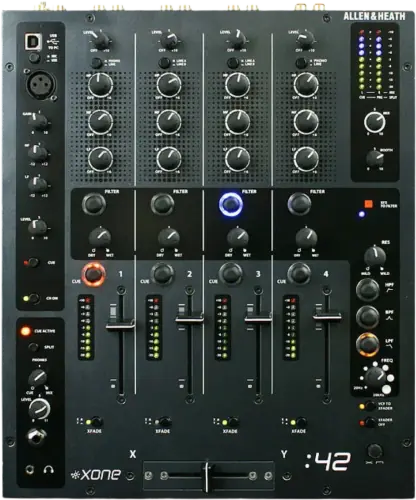
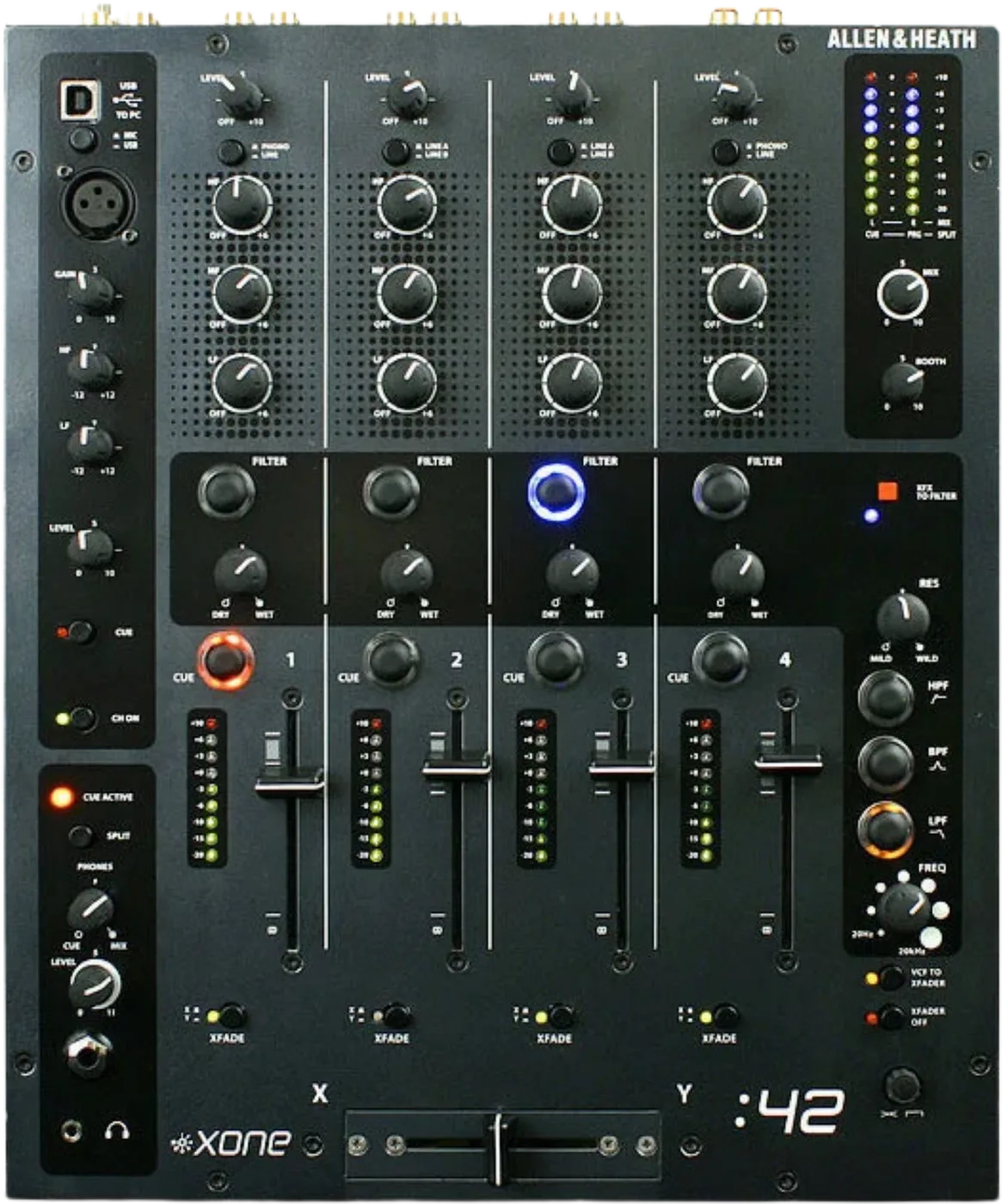
Booth briefing. The Xone:42 is a four channel analogue club mixer from Allen & Heath with one analogue filter shared between the channels. Phono switching is on channels 1 and 4, and channels 2 and 3 take two line sources each. A USB socket feeds the Mic/USB channel for playback from a computer, and recording over the same socket is patched on the rear from RECORD OUT to USB IN. The filter comes up as a low-pass at power-on. Allen & Heath have since withdrawn the Xone:42 from their range.
When it goes wrong: No sound from the mixer
Fast Lane
The five things that decide your gig
The five things on the Xone:42 that change what happens next, if you are reading this in the booth. All five are explained in full further down this page.
Only two of the four channels take a turntable.
Phono and line switching is on channels 1 and 4 only. Channels 2 and 3 are Line A and Line B, two line sources each, with no phono input and no RIAA stage behind them.
So a deck plugged into channel 2 or 3 is thin and quiet, the cartridge is fine, and there is nothing on the mixer to fix it. Move it to channel 1 or 4.
USB plays into the mixer out of the box. It records nothing until you run one cable.
The USB socket is not internally connected to the mix. A phono cable has to be run on the rear panel from RECORD OUT to USB IN before a computer sees your mix at all, so plugging in USB and pressing record gives silence.
Playback is the other direction and it is already wired: Playback is wired and needs nothing extra. Select USB on the switch beside the socket and the computer plays into the Mic/USB channel. The same signal also appears on the rear USB OUT phonos, so it can be patched into one of the four line inputs instead.
The filter forgets what it was. It always comes back as a low pass.
Allen & Heath publish it plainly: The last selected type is lost when power is removed from the console. The LPF is always selected when power is applied.
So the mixer you set up before doors is not the mixer you come back to after a power cut, and the knob under your hand is not doing what it did last time.
The master does not touch the booth, and it does not move the meters either.
Master is a rotary control over the main mix XLR outputs, and Allen & Heath state it "does not affect the booth output or the meter reading". The booth output is separately described as "not affected by the master fader or cue system".
Pull the master down and the booth stays exactly as loud as it was. That is the mixer working as designed, not a fault to chase.
The crossfader is a consumable, and Allen & Heath wrote that into the warranty.
One year, and Allen & Heath state that it explicitly "does not cover fader wear and tear".
A manufacturer excluding a part from its own warranty is the clearest statement available that the part is expected to wear out. Plan a spare rather than being surprised by one.
If something goes wrong
A turntable sounds thin and quiet and the cartridge is fine
Short answer. Look at which Xone:42 channel it is in. Phono and line switching is on channels 1 and 4 only. Channels 2 and 3 are Line A and Line B, two line sources each, with no phono input and no RIAA stage behind them.
Why this happens. A phono input is not just a socket. It is a socket with a preamplifier and RIAA correction behind it, which raises a cartridge's very low output and puts the bass back that the record cut removes. Send a cartridge into a line input and you get neither: the level is far too low and the tonal balance is wrong in a way that sounds like a worn stylus or a failing cartridge. Nothing on the panel warns you, because channels 2 and 3 have a source switch of their own that simply picks a different line input.
Fix it now. Move the turntable to channel 1 or channel 4 and set the switch to PHONO. Two turntables go on 1 and 4. That is the whole fix and it takes as long as swapping two cables.
Avoid it next time. If you play vinyl on this mixer regularly, label channels 1 and 4 on the panel. In a shared booth it is the single most useful piece of tape you will ever apply.
USB is connected, the computer sees the mixer, and the recording is silent
Short answer. Nothing is broken, and the Xone:42 needs one cable you were not told about. The USB socket is not internally connected to the mix. A phono cable has to be run on the rear panel from RECORD OUT to USB IN before a computer sees your mix at all, so plugging in USB and pressing record gives silence.
Why this happens. Nearly every mixer with a USB socket sends its mix down that socket without being asked. This one does not, by design: the codec's input is brought out to a pair of phono sockets on the rear rather than being tied to a bus inside, so it can be used as an insert or a return instead. The consequence is that the computer sees a healthy recording device receiving nothing, which looks exactly like a software problem and is not one.
Fix it now. Take a stereo phono cable and run it on the rear panel from RECORD OUT to USB IN. Then select USB Audio CODEC as the recording device in your software. That is the whole fix.
Avoid it next time. Leave the cable permanently fitted. It takes one short lead, it is invisible from the front, and it turns the socket into the thing everyone assumed it already was. In a venue you do not control, carry the lead.
The filter is not doing what it did last time you used it
Short answer. The Xone:42 has reset it for you. Allen & Heath publish it plainly: The last selected type is lost when power is removed from the console. The LPF is always selected when power is applied.
Why this happens. The type selection is not stored. Whatever you left it on when the mixer went off is gone, and it comes back as a low-pass every time. So a DJ who ended the last gig sweeping a high-pass reaches for the same knob at the start of this one and gets the opposite effect, which in a build is the difference between tension and a hole in the middle of the track.
Fix it now. Look at the three illuminated switches before you touch the frequency knob. The lit one is the type you are about to hear.
Avoid it next time. Make setting the filter type part of your line check, in the same pass as the gain and the booth level. It takes one second and it is the only setting on this mixer that actively lies to your muscle memory.
The master is down and the booth is still loud
Short answer. Nothing on the Xone:42 is wrong. Master is a rotary control over the main mix XLR outputs, and Allen & Heath state it "does not affect the booth output or the meter reading". The booth output is separately described as "not affected by the master fader or cue system".
Why this happens. The booth feed is taken before the master control rather than after it, which is deliberate: a DJ adjusting the room should not lose their own monitoring while doing it. The side effect is that the master is not a global volume and cannot be used as one, and the meters do not follow it either, so the thing you would normally glance at to confirm the change is not confirming anything.
Fix it now. Use the booth level control for the booth. If you need the whole room down at once, including the booth, that is two controls on this mixer and it is worth knowing which two before the moment you need them.
Avoid it next time. On an unfamiliar Xone:42, find the booth control before the first track. It is the one that will be missing from your hand when somebody asks you to turn it down.
What to watch for
Allen & Heath have withdrawn it, and the documents are hard to reach
What happened. The Xone:42 is off the range and hard to research. Allen & Heath have removed the product page for this mixer. It survives on their site only as a documents ZIP under Legacy Products, and its specifications exist nowhere except inside the User Guide, publication AP6857, Issue 4, copyright 2007.
Why that matters to you and not only to us. A product with no page has no published specification you can check a seller's claim against, and the one document that holds the numbers is inside a ZIP rather than a link you can open on a phone in front of the mixer. If you are buying one secondhand, download the guide before you go and look at it, not after.
What they do not say. Allen & Heath publish no discontinuation date and no successor statement. They never say the Xone:43 replaces it, so this page does not say so either. Allen & Heath publish no service manual and no schematics for this mixer.
What that changes about owning one. Parts are officially numbered and the fader plate is already gone, which is a realistic picture of a withdrawn product rather than a warning against it. Buy on condition, not on the assumption that anything can be replaced.
The filter numbers do not exist, and nobody should quote them
Short answer. Nobody can quote you a Xone:42 filter number, because there is not one to quote. Allen & Heath publish no filter slope in dB per octave, no Q figures and no response graph.
Why we are saying so out loud. Figures for this filter circulate. They are repeated confidently, they vary between sources, and none of them traces back to Allen & Heath. A number with no origin is worse than no number, because it invites a comparison that the evidence cannot support, and comparing this filter to another one on borrowed figures is how people end up disappointed by a mixer that is doing exactly what it should.
What you can rely on instead. The published behaviour: the sweep range, the band limit on two of the three types, the resonance description, and the fact that engaging the filter always changes the sound. That is enough to work with and all of it is theirs.
Compatibility
The USB socket, and the cable nobody tells you about
Short answer, and it has two halves that behave differently. The Xone:42 USB socket is wired one way and not the other. Playback is wired and needs nothing extra. Select USB on the switch beside the socket and the computer plays into the Mic/USB channel. The same signal also appears on the rear USB OUT phonos, so it can be patched into one of the four line inputs instead. Recording is the other way round: The USB socket is not internally connected to the mix. A phono cable has to be run on the rear panel from RECORD OUT to USB IN before a computer sees your mix at all, so plugging in USB and pressing record gives silence.
Allen & Heath say it themselves. Their support article puts it in one sentence: The USB socket isn't internally configured to carry the Record Output signal, but as default is set as a "patchable send." That is the operationally useful description, and it is not the one in the User Guide, which frames the same default as being configured for external input allowing the USB interface to be connected to the insert point and used as an effects unit. Both are Allen & Heath. The support wording is the one that tells you to go and find a phono cable.
What the codec actually is. USB type B, V1.1, carrying one uncompressed stereo pair in each direction, with the USB Audio I/O appearing on RCA. The computer names it USB Audio CODEC. It is class compliant, so nothing is installed on either platform.
The published compatibility has not moved since. Allen & Heath's published operating system list for the USB codec stops at Windows XP and OS X 10.0, and they publish no update to it. In practice a class compliant device of this kind is still recognised, and we are reporting what is published rather than what is claimed by anyone else. If a recording matters, test it on the actual laptop before the gig depends on it.
Common mistakes. Plugging in USB, pressing record, and getting silence, then looking for a driver or a setting. There is no driver and there is no setting. There is a cable.
Features explained
The four channels, and the two that take a turntable
Short answer. Phono and line switching is on channels 1 and 4 only. Channels 2 and 3 are Line A and Line B, two line sources each, with no phono input and no RIAA stage behind them.
Why this is the first thing on the page. Every four-channel mixer a DJ has used since is four phono channels by default, so the assumption arrives with the reader rather than being formed by the mixer. Nothing on the front panel of channels 2 and 3 looks different at a glance: there is a source switch there too, it just selects between two line inputs instead of between phono and line. A turntable on one of those goes straight into a line input with no RIAA correction, which is quiet, bass-light and treble-heavy, and reads as a cartridge problem or a cable problem to anyone who has not been told.
Can it be changed. Not by you, and not for free. Allen & Heath put it plainly: You can mod a PHONO input to LINE by bypassing some components, but going the other way round requires the addition of special filter circuitry. Four phono channels means having the input cards specially fitted, either before sale through the supplier or afterwards by a service centre, and Allen & Heath state that it is chargeable.
What each channel gives you. A level control, the source switch, three bands of EQ, a Filter Select button, an X:FX send, a cue switch, a 60 mm fader and an X or Y crossfader assign. The Mic/USB channel is the exception on almost all of it, and it is covered below.
Common mistakes. Setting up two turntables on channels 1 and 2 because that is where the hands go, rather than on 1 and 4 because that is where the phono stages are.
The filter, one block shared by four channels
Short answer. One analogue stereo VCF, state variable, shared across the mixer. Each of the four main channels has its own Filter Select switch that routes it into the filter, and the filter returns to the main mix bus, so several channels can be driven into it together.
The part people get wrong. This is not a filter per channel and it is not a filter across the mix. It is one block with four doors into it. Two channels sent into the filter together are filtered together, by one frequency knob, with one resonance setting, which is a creative tool if you meant it and a surprise if you did not. The X:FX return can be pushed into the same block with its own button.
The three types, and combining them. High-pass, band-pass and low-pass, each on its own illuminated switch, and Allen & Heath encourage stacking: You can press any combination together to create different response types such as "notch" and an interesting "all-pass" effect. The sweep covers 20 Hz to 20 kHz, with one published caveat worth knowing before you reach for it in a build: Both BPF and HPF filters are band limited to prevent them going above 10kHz.
Resonance. Allen & Heath describe the range as one that ranges from "mild" producing a very subtle effect, to "wild" producing a dramatic phase effect with feedback just short of oscillation. That last part is literal. At the top of the range the circuit is close to self-oscillating, which is the sound people buy this mixer for and also the setting that will take a room's ears off if you open a channel into it.
It is allowed to colour the sound. Allen & Heath publish that engaging the filter always changes the sound, because the signal is "physically switched through different analogue circuitry", and that this holds even at MILD with the HPF at 20 Hz. They class it as normal rather than as a fault.
And the crossfader can drive it. The crossfader can drive the filter sweep in place of the FREQ knob, and Allen & Heath add that "Disabling the crossfader will also disable this function."
The mic channel, and the one thing it cannot do
Short answer. One mic input on a 3-pin XLR, sharing a channel with the USB codec through a source switch. It has two bands of EQ rather than three, a rotary level rather than a fader, a cue switch and an on switch.
The limit. The Mic/USB channel has no Filter Select button. The filter covers the four main channels and nothing else, so a microphone cannot be put through it. So the trick of sweeping a filter across a vocal is not available on this mixer, and no setting will make it available.
What is not published, and we are not guessing. Allen & Heath do not publish whether the mic reaches the booth or the record output on this mixer, and there is no rear panel mic routing switch to read the answer off. If your gig depends on the mic reaching the booth speakers or the recording, test it in the room rather than assuming either way.
Common mistakes. Planning a set around filtering a microphone, and finding out during the set. Planning a recorded speech handover without checking whether the mic is in the recording.
The master is narrower than it looks, and the record feed is earlier
Short answer. Master is a rotary control over the main mix XLR outputs, and Allen & Heath state it "does not affect the booth output or the meter reading". The booth output is separately described as "not affected by the master fader or cue system".
Read that twice, because it is two surprises. Turn the master down and the booth does not follow, so a DJ dropping the house level to talk to somebody still has the booth at full volume. Turn the master down and the meters do not follow either, so the meters keep telling you about the mix rather than about what the room is getting. Neither is a fault. Both are what the mixer is built to do.
And the recording is taken before it. Allen & Heath specify the record feed as POST channel fader levels, but PRE main MIX level. So your recording ignores the master control entirely: riding the master down at the end of your set does not fade the recording, and a master left low does not make a quiet recording.
What is not published. Allen & Heath publish no unity marking for the rotary MIX control. There is no printed unity mark to set it to, so gain staging on this mixer is done by ear and by the meters rather than by a position on the panel.
The channel changes tone the moment the filter is engaged
Short answer. That is documented Xone:42 behaviour, not a fault. Allen & Heath publish that engaging the filter always changes the sound, because the signal is "physically switched through different analogue circuitry", and that this holds even at MILD with the HPF at 20 Hz. They class it as normal rather than as a fault.
Why this happens. Pressing Filter Select does not arm anything, it physically routes the channel through a different analogue circuit. That circuit has a sound whether or not you have moved the frequency knob, and no setting returns it to bit-perfect. On a mixer people buy for its filter, that is arguably the point.
Fix it now. Nothing to fix. If you need the channel clean, take it out of the filter rather than trying to null the filter out with the controls.
Avoid it next time. Do not engage the filter as a habit on channels you are not filtering. Leave it out of the path until you want it.
Professional tips
Before you open the first channel
Put the turntables on 1 and 4 while you are still cabling. Phono switching exists on those two channels only, and a deck on channel 2 or 3 sounds like a dying cartridge. It is a thirty second decision at load-in and an unsolvable mystery at showtime.
Leave a short phono cable tied to the back of the mixer. One stereo lead from RECORD OUT to USB IN is the difference between a USB socket that records and one that does not. It lives on the mixer, it is invisible from the front, and it removes the only genuinely counterintuitive thing about the unit.
Check which filter type is lit before your first build. The mixer forgets the type at power-off and always comes back as a low-pass. Glancing at three lit switches takes a second. Reaching for a high-pass and getting a low-pass loses you a transition.
Learn the booth control before you need it. The master does not touch the booth and does not move the meters, so the control you reach for when somebody says it is too loud is not the one you expect. Find it before the first track.
Treat the crossfader as a wear part. Allen & Heath exclude fader wear from the warranty in writing, the replacement is documented, and the plate needed for the Penny and Giles option is discontinued. If you are buying one secondhand, work the crossfader end to end before you agree to anything.
The crossfader is a consumable, and Allen & Heath say so
Short answer. One year, and Allen & Heath state that it explicitly "does not cover fader wear and tear". A manufacturer writing an exclusion into its own warranty is the clearest statement available that the part is expected to wear out, and it should change how you plan rather than how you feel about the mixer.
Their own documents disagree about who replaces it. Page 18 of the User Guide says to contact an approved service centre. Pages 26 to 27 of the same guide print a full owner facing step by step, naming a T10 Torx and cross-point screws. Both are in the same guide. Read that as: it is a documented owner-level job, and Allen & Heath would rather a service centre did it. If the mixer is under warranty or you are not confident with a Torx driver, take the second sentence.
The part numbers, and why there is more than one. The standard Alpha fader is Alpha 003-829 JIT in Issue 4 of the guide, and Alpha 002-784 JIT in Issue 1 of the same publication. That is a revision across issues rather than two options, so an older unit and a newer one can want different parts and the guide in your hand may not be the one that matches your mixer. Check the issue number on the document before you order.
The Penny and Giles route. The part is 002-719 JIT. The support article splits the Penny and Giles part by front panel colour, 002-719JIT for silver and 003-914JIT for storm grey, and warns that the plate colour may not match. And there is a catch that stops the job before it starts: The fader plate needed to fit a Penny and Giles crossfader is AA7492, and Allen & Heath say "this metalwork is discontinued so stock may now be exhausted".
What is not published. Allen & Heath publish no crossfader curve in numbers, and do not state which crossfader ships as standard today. So if the curve on a secondhand unit feels wrong, there is no published reference to compare it against.
Connections and setup
The rear panel, and what is not on it
Short answer. IEC mains, phono in on RCA with RIAA for channels 1 and 4, line in for channels 1 and 4, Line A and Line B for channels 2 and 3, mic in on 3-pin XLR, USB type B, USB Audio I/O on RCA, X:FX send and return on RCA, a balanced XLR mix output, an RCA booth output, an RCA record output, and a chassis earth screw terminal for turntable earth straps.
The thing to know before you go looking. There are no switches on the rear panel at all. Phono and line selection, and the Line A and Line B selection, are on the FRONT. That is unusual enough to waste real time. A DJ who has decided the phono selection must be a switch on the back will spend a torch and five minutes finding out it is not, and the switch is under their hand the whole time.
The effects loop. X:FX is a send and return pair on RCA, fed by a dry and wet control on each of the four channels. Fully wet sends everything to the loop, and on that channel it bypasses the filter, which is worth knowing before you wonder why the filter stopped working on one channel. The return lands on the mix, or in the filter if you press the button for it.
The headphone section. A quarter-inch TRS and a 3.5 mm socket, rated by Allen & Heath "between 30 to 100 ohms impedance. 8 ohm headphones are not recommended". Split Cue overrides the left channel only and leaves the programme in the right, and selecting it automatically overrides the Cue/Mix blend control.
The crossfader. A 45 mm stereo VCA crossfader, specified as replaceable, with per-channel X and Y assign, a curve from dipped to fast-attack, and a defeat switch that turns it off entirely.
Firmware, drivers and manuals
Official downloads and documents
Go to Allen & Heath for the files themselves. We link their pages instead of hosting a copy, because a manual copied here is a snapshot of release day and theirs is the one that stays current.
Manuals. Official Allen & Heath manual page →
Broken link? Let us know and we'll fix it.
Frequently asked questions
Quick answers
- Can I run four turntables on it?
- No. Phono and line switching is on channels 1 and 4 only. Channels 2 and 3 are Line A and Line B, two line sources each, with no phono input and no RIAA stage behind them.
- Can the other two channels be converted to phono?
- Not by you. Four phono channels means having the input cards specially fitted, either before sale through the supplier or afterwards by a service centre, and Allen & Heath state that it is chargeable.
- Why is my USB recording silent?
- The USB socket is not internally connected to the mix. A phono cable has to be run on the rear panel from RECORD OUT to USB IN before a computer sees your mix at all, so plugging in USB and pressing record gives silence.
- Does the USB work for playback?
- Yes, and it needs no extra cable. Playback is wired and needs nothing extra. Select USB on the switch beside the socket and the computer plays into the Mic/USB channel. The same signal also appears on the rear USB OUT phonos, so it can be patched into one of the four line inputs instead.
- Do I need a driver?
- No. The computer names it USB Audio CODEC. It is class compliant, so nothing is installed on either platform.
- Why is the filter always a low-pass when I switch on?
- The last selected type is lost when power is removed from the console. The LPF is always selected when power is applied.
- Can I filter the microphone?
- No. The Mic/USB channel has no Filter Select button. The filter covers the four main channels and nothing else, so a microphone cannot be put through it.
- How many filters does it have?
- One, shared. Each of the four main channels has a switch that routes it into that one block, so channels sent in together are filtered together.
- Does the master control the booth output?
- No. Master is a rotary control over the main mix XLR outputs, and Allen & Heath state it "does not affect the booth output or the meter reading". The booth output is separately described as "not affected by the master fader or cue system".
- Does the master affect the recording?
- No. The record feed is POST channel fader levels, but PRE main MIX level.
- Can I replace the crossfader myself?
- Allen & Heath's own guide says both. Page 18 of the User Guide says to contact an approved service centre. Pages 26 to 27 of the same guide print a full owner facing step by step, naming a T10 Torx and cross-point screws.
- Is it still made?
- No. Allen & Heath have removed the product page for this mixer. It survives on their site only as a documents ZIP under Legacy Products, and its specifications exist nowhere except inside the User Guide, publication AP6857, Issue 4, copyright 2007.
- What is the filter slope?
- Allen & Heath publish no filter slope in dB per octave, no Q figures and no response graph.
Where this sits in the line
- Next generation Xone:43
Related mixers
Commonly paired with
What you usually find beside it in working booths, from club, festival and rental installs rather than from a manufacturer document.
Allen & Heath All brands Knowledge base FAQ and Fixes Dictionary
Playing soon and it is not working?
Start Emergency ModeKeep the Emergency Card
We will email you the printable PDF so it is on your phone before the next dark booth. Occasional notes that save gigs. No spam, unsubscribe in one click.
Registering is free and counts everywhere on Save My Gig. We send a confirmation email first. Your address is stored with Brevo, our email provider. Unsubscribe any time. Privacy
Sources: Allen & Heath's Xone:42 User Guide, publication AP6857, Issue 4, copyright 2007, and five of their own support articles, checked 12 August 2026. Specifications theirs, priorities ours.