

Xone:43, the field manual
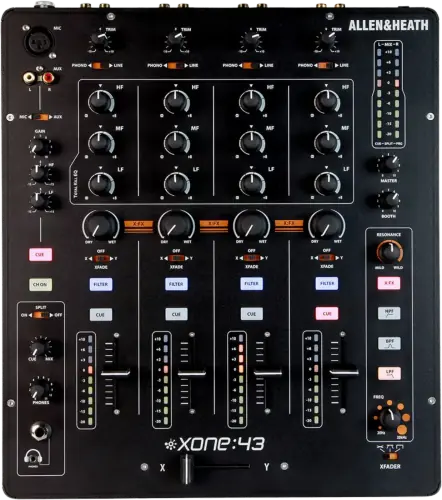
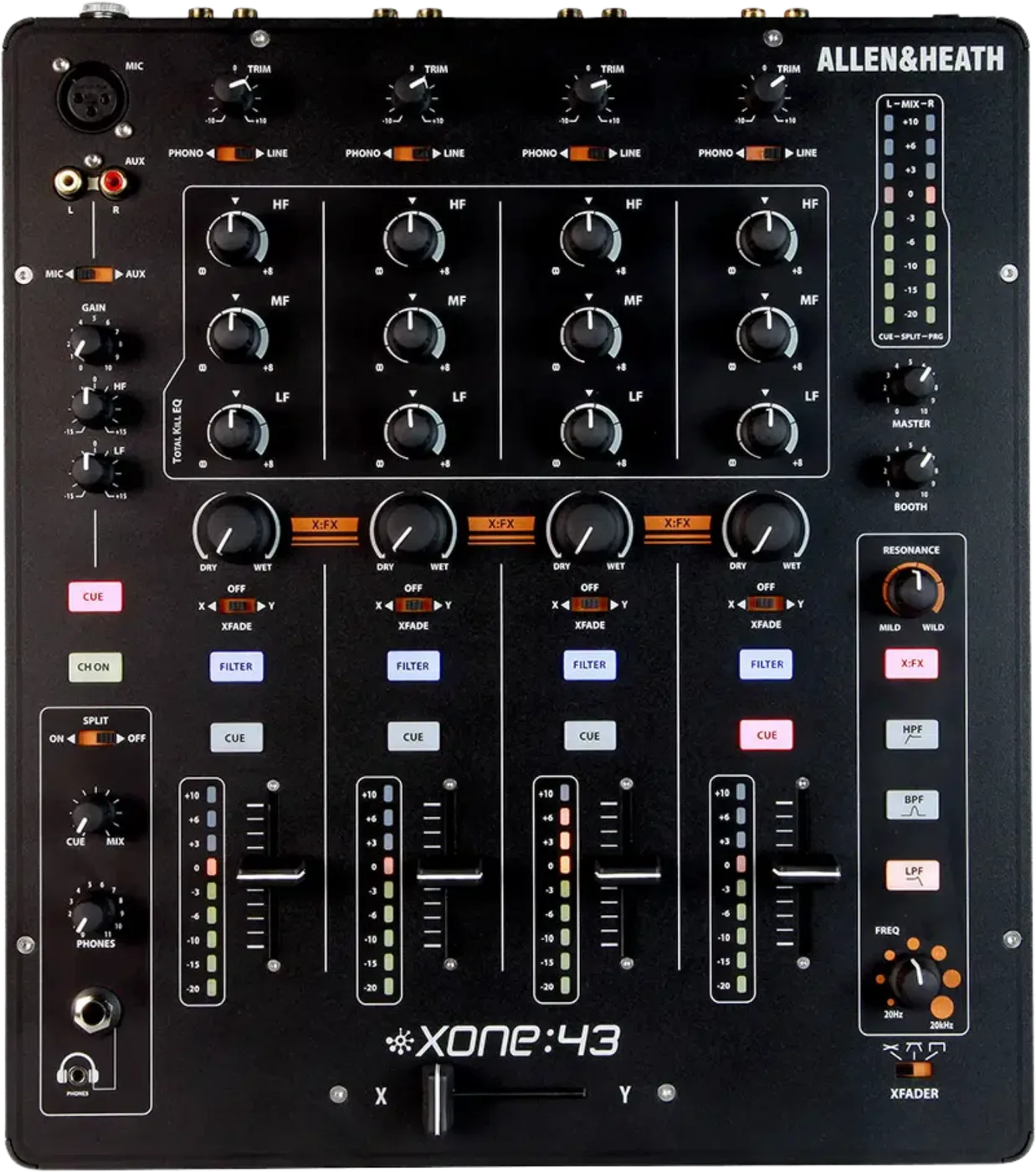
Booth briefing. The Xone:43 is Allen & Heath's four channel analogue club mixer, and every channel takes a turntable through its own Phono/Line switch. It is fully analogue: no USB socket, no soundcard, no MIDI and no firmware, so timecode into a computer needs a separate interface. One filter is shared across the mixer, and a channel reaches it when its Filter Select is lit. Crossfader assignment is X or Y per channel, with no crossfader on/off switch. X:FX is a send and return loop with a dry/wet knob on every channel.
When it goes wrong: No sound from the mixer
Fast Lane
The five things that decide your gig
The five things on the Xone:43 that change what happens next, if you are reading this in the booth. All five are explained in full further down this page.
There is no crossfader on/off switch, and that is how a channel goes silent with its fader up.
There is no crossfader on/off switch on this mixer, unlike the Xone:24. A channel assigned to X or Y with the crossfader parked at the other end is silent with its channel fader up, its channel meter still reading normally because that meter is pre-fader, and every light on the mixer looking normal, and the only way out is that channel's own assign switch.
All four channels take a turntable, so a thin deck is a switch, not a fault.
All four channels take a turntable. The rear panel list reads "CH 1, 2, 3 and 4 PHONO Inputs" alongside "CH 1, 2, 3 and 4 LINE Inputs", so there are four RIAA stages and four decks can be connected at once, with each channel choosing its source on its own Phono/Line switch.
Thin and quiet means the switch is on Line with a cartridge feeding it. Horribly loud and distorted means the opposite. Check that channel before you blame the deck or the needle.
One filter, shared, and a channel only reaches it through its own Filter Select.
One stereo analogue Voltage Controlled Filter, shared across the mixer. It is not a filter per channel and it is not the twin-filter arrangement of the Xone:92 and Xone:96.
A channel reaches the filter only through its own Filter Select switch, which illuminates to show that the channel is being sent to the filter. Pressing HPF, BPF or LPF does nothing at all to a channel that is not assigned.
The last selected filter type is lost when power is removed, and LPF is always selected when power is applied, so every power up starts on low pass however the mixer was left.
There is no USB socket on this mixer at all.
There is no USB socket on this mixer. No soundcard, no MIDI, no converters and no firmware. This is an absence of a connector rather than a feature left switched off.
So there is no timecode into a computer, no driver to install and no setting to find. The Xone:43C is the one with the soundcard, and it is a different mixer.
X:FX is a real send and return loop, so guitar pedals belong in it.
X:FX is a true send and return loop rather than an insert, with a dry/wet send knob on each of the four channels and RCA send and return on the rear. The return can go straight to the mix bus or be pushed into the filter with the X:FX Return to Filter button.
A loop with a dry and wet control per channel is a different instrument from an insert: you can drive one channel hard into a pedal and leave the other three alone.
With a channel's X:FX dry/wet control fully wet, all of that channel's signal is sent to external effects and the VCF filter is bypassed. In the central position half goes to the loop and, if filter is selected, only the dry part of the signal is filtered.
If something goes wrong
A channel is silent, the fader is up and nothing looks wrong
Short answer. Look at that Xone:43 channel's XFade Assign switch. There is no crossfader on/off switch on this mixer, unlike the Xone:24. A channel assigned to X or Y with the crossfader parked at the other end is silent with its channel fader up, its channel meter still reading normally because that meter is pre-fader, and every light on the mixer looking normal, and the only way out is that channel's own assign switch.
Why this happens. On most mixers a crossfader can be switched out of the way in one move. Here it cannot, so the crossfader is always in the path of any channel assigned to X or Y, and a fader left at one end is a mute switch for half the mixer. The cue still works and there is nothing else on the panel to see.
What the channel meter is telling you. The channel meter is pre-EQ and pre-fader, so it shows the input level even with every EQ band killed and the fader down. A channel that meters normally and cannot be heard has its problem downstream of the meter, not at the input. On this fault the meter reads normally while the room hears nothing, and that disagreement is the clearest evidence you have that the input side is fine.
Fix it now. Put that channel's assign switch to the middle, OFF, which sends it straight to the mix bus. Or move the crossfader. The first one is the fix; the second one is a decision about the other channels.
Avoid it next time. Park every channel you are not cutting with on OFF during the line check, and leave the crossfader centred. Then a fader up always means audio.
The filter knob is doing nothing to the channel you are playing
Short answer. That Xone:43 channel is not assigned into the filter. A channel reaches the filter only through its own Filter Select switch, which illuminates to show that the channel is being sent to the filter. Pressing HPF, BPF or LPF does nothing at all to a channel that is not assigned.
Why this happens. The filter block sits on the right of the panel, away from the channel strips, so it reads as a master effect that is simply on. It is not: it is one shared circuit and the only thing that connects a channel to it is that channel's own Filter Select switch, which lights up when it is engaged. The knob was working the whole time. It was working on nothing.
The second cause, and it is on the channel strip. With a channel's X:FX dry/wet control fully wet, all of that channel's signal is sent to external effects and the VCF filter is bypassed. In the central position half goes to the loop and, if filter is selected, only the dry part of the signal is filtered.
The third, if the mixer has just been switched on. The last selected filter type is lost when power is removed, and LPF is always selected when power is applied, so every power up starts on low pass however the mixer was left.
Fix it now. Press Filter Select on the channel you want, put that channel's X:FX dry/wet knob back off fully wet, and check which filter type buttons are lit before you sweep, because everything in there moves together.
Avoid it next time. Set the filter assignments in the same pass as the gains, during the line check, and glance at the lit switches before your first build.
A turntable is thin and quiet, or horribly loud and distorted
Short answer. The Xone:43 channel's Phono/Line switch is in the wrong position, and which way it is wrong decides which of those two things you are hearing.
Why this happens. A phono input has a preamplifier and RIAA correction behind it: it lifts a cartridge's tiny output and puts back the bass the record cut removed. A deck sent into a line input gets neither, so it is far too quiet and tonally wrong in a way that sounds like a failing stylus. The other way round, a line source into the phono input overloads the preamp, and Allen & Heath say exactly what that sounds like: Do not plug in line level sources to the phono inputs as these will overload the preamp and cause severe high level distortion.
Fix it now. Flip that channel's Phono/Line switch. Every one of the four channels has both inputs and both are live, so nothing needs moving to another channel.
Avoid it next time. Set all four switches during the line check and look at all four, not just the two you are opening first. The switches are small and the panel is dark.
The cue is only in one ear
Short answer. The Xone:43 has Split Cue switched on. Split Cue overrides just the left side of the headphones with the cue signal and leaves the programme in the right, and the left main meter then shows cue while the right shows programme. It also automatically overrides the Cue/Mix control.
Why this happens. Split Cue is a beat mixing tool rather than a fault, and it is a small switch in the headphone block that whoever played before you may have left on. Nothing in the headphones has failed, which is why swapping them changes nothing, and the Cue/Mix knob appearing dead is the same switch and not a second problem.
Fix it now. Switch Split Cue off. The Cue/Mix control comes back at the same moment, because Split Cue overrides it while it is on.
Avoid it next time. Look at the Split Cue switch and the Cue/Mix knob in the same pass as the gains, before the first record.
The meters read and the room is quiet
Short answer. The Xone:43 meters are not fed from the master control. The master level control moves the XLR outputs only. It does not affect the booth output and it does not affect the meter reading, so the meters can sit at 0 with a silent room.
The other half of it. The main meters follow the selected monitor source. They show the mix level, pre-master, until a channel cue switch is pressed, and then they show that channel instead. A cue button left engaged is enough to make the main meters stop describing the mix.
Fix it now. Look at the master knob before anything else, then release every cue button and watch the meters. Meters that move when you release a cue were showing you one channel, not the mix.
Avoid it next time. Read these meters as a picture of the mix before the master, because that is exactly what Allen & Heath say they are, and judge the room by the room.
There is a hum or a buzz under everything
Short answer. The Xone:43 carries a chassis earth terminal on the rear panel and it exists for exactly this. A screw terminal is provided for connecting the earth straps from turntables. This connection earths the metal parts of the turntable to reduce hum, buzz or similar audible noise getting into the system.
Why this happens. Four channels of phono means up to four earth straps, and a strap left dangling is a hum on that channel. Beyond the decks, a signal that sees more than one path to mains earth makes a loop, and that loop is heard as a mains frequency hum or buzz.
Fix it now. Land every turntable earth strap on the screw terminal first, because that is one wire and half a minute. Do not remove the earth connection from the console mains plug: the chassis is earthed through the power cable for the operator's safety and audio 0V is connected to the chassis internally. Where an earth loop is the problem, operate the ground lift switches on the connected equipment, or disconnect the cable screens at one end, usually at the destination.
Avoid it next time. Make the earth straps part of the same pass as the audio cables, and never pull the earth pin on the mains lead to chase a buzz.
What to watch for
Where this mixer stands, in Allen & Heath's own words
Status. The Xone:43 is still on the range page and there is no notice either way. Allen & Heath list this mixer in the current Xone range and do not file it under legacy products. They have published no statement that it remains in production and no end-of-life notice either, so this page reports what their range page shows and nothing beyond it.
When it arrived. Trade coverage dated the launch to April 2015, with DJWorx reporting it as shipping immediately. Allen & Heath publish no dated announcement for this mixer, so no launch year is stated in this site's data and the month above is attributed to the press rather than to the manufacturer.
Faults. No recalls and no service bulletins for this mixer were found in Allen & Heath's knowledge base. That is a null result and not a reliability verdict, and this page does not turn it into one in either direction.
What owners and reviewers say. Reviewers complain that the dark panel makes the channel faders and the meters hard to read in a dark booth. That is a field observation about a paint job, and it is here because it is the thing owners mention first. DJWorx reported an audible crackle when engaging the filter on the 43C, which is the same analogue platform, and a perceived level lift with the filter in. Allen & Heath have published nothing about it and there is no service bulletin, so it stays a review report rather than a documented fault. The channel faders are 45 mm, shorter than the 60 mm on the Xone:42 and the Xone:92, so there is less travel for fine level work. That is a specification, and how much it matters is a matter of hands.
What is not documented, and will not be invented here
The filter tap point. The one Xone:43 answer this page cannot give you. Allen & Heath do not state whether this filter sits before or after the channel fader. Their Xone:24 and Xone:24C guides do state it for those mixers, post-gain, post-EQ and post-fader. This guide does not, and carrying another model's answer across would be a guess with a citation stapled to it.
Mic routing. Allen & Heath do not state whether the Mic/Aux channel reaches the booth or the record output. The guide says only that the channel on switch sends it to the main mix, and there is no clean feed circuit mentioned anywhere in this guide, which is notable given how prominent one is on the Xone:92 and Xone:96. Absence of mention is not proof of absence, so if a promoter needs the mic on the recording, test it before doors.
Where the mic socket is. Allen & Heath do not state which panel the mic XLR and the aux RCAs sit on. They are not in the guide's eight-item rear panel list, and no location is inferred here from product photography.
Rack height. Neither the rack kit article nor the fitting guide states how many rack units the mixer occupies once the ears are on, so no U figure is given here.
Which crossfader is fitted. Allen & Heath do not state which of the two crossfaders ships in the box. The specification table says only "45mm stereo VCA - replaceable", and the parts article lists one as standard and one as an option without saying which one is already in your mixer.
Where it is built. Allen & Heath publish no country of manufacture for this mixer. What they publish is a policy: they build in both the United Kingdom and China, to the same standard, and they name no models on either side of that line.
Why we say all this out loud. Every one of those gaps has a confident answer circulating somewhere, and a figure with no origin invites a comparison the evidence cannot support. Naming the absence is the only version of this that stays true.
Compatibility
There is no USB socket, and the 43C is the one with the soundcard
Short answer. There is no USB socket on this mixer. No soundcard, no MIDI, no converters and no firmware. This is an absence of a connector rather than a feature left switched off.
DVS. Serato list DVS support for the Xone:DB2, the Xone:DB4 and the Xone:43C, and they do not list the Xone:43. This mixer is not a DVS desk for any platform and nothing about it can be configured to become one, because timecode has no way into a computer from here.
The variant that does have it. The Xone:43C is the same mixer with a 96 kHz 24-bit 16-channel USB soundcard, X:LINK for the K-series controllers and Serato DJ support that needs a Club Kit licence. Allen & Heath file it under legacy products on their own site, which is a manufacturer statement that it is discontinued, and their support section covers the pair together as "43 & 43C".
What that means if you have a laptop. Your interface goes into any of the four channels on line, and the mixer never knows a computer is in the room. Nothing needs installing, nothing can be out of date, and no update can break the night. That is the trade this mixer makes and it is a real one in both directions.
Common mistakes. Buying a Xone:43 on the strength of a review of the Xone:43C. They are not the same purchase, and only one of them is on Serato's list.
The computer cannot see the mixer
Short answer. It never will. There is no USB socket on this mixer. No soundcard, no MIDI, no converters and no firmware. This is an absence of a connector rather than a feature left switched off. There is no driver to install and no setting to find, because there is no device for the computer to enumerate.
Fix it now. Put an audio interface between the two and take its outputs into any channel on line. All four channels have a line input, so a laptop can go anywhere.
If you were promised timecode. Check the model badge. Serato list DVS support for the Xone:DB2, the Xone:DB4 and the Xone:43C, and they do not list the Xone:43. This mixer is not a DVS desk for any platform and nothing about it can be configured to become one, because timecode has no way into a computer from here.
Avoid it next time. The interface is part of the rig on this mixer, not an accessory. A laptop and a USB cable is a laptop with no way into the room.
Features explained
Four channels, and every one of them takes a turntable
Short answer. All four channels take a turntable. The rear panel list reads "CH 1, 2, 3 and 4 PHONO Inputs" alongside "CH 1, 2, 3 and 4 LINE Inputs", so there are four RIAA stages and four decks can be connected at once, with each channel choosing its source on its own Phono/Line switch.
Why this is the first thing on the page. That is the documented difference from the Xone:42, which puts phono on two channels of four, and it is the reason a DJ who knows the older mixer should not assume the older layout. The two mixers look alike from a metre away and carry the same four channel strips, and on the older one two of those strips have no RIAA stage behind them. If your habit came from a Xone:42, unlearn it here: on this mixer there is no wrong channel for a deck, only a wrong switch position.
What each channel gives you. Four stereo channels, each with its own phono and line inputs and a switch to pick between them, plus one Mic/Aux channel. Allen & Heath count it as 4 + 1. Each strip carries a gain trim, three EQ bands, an X:FX dry/wet send, a Filter Select switch, a crossfader assign switch, a cue button and a 45 mm fader.
The one that is loud rather than quiet. Allen & Heath's warning is blunt: Do not plug in line level sources to the phono inputs as these will overload the preamp and cause severe high level distortion. A line source in a phono input does not fail silently the way a deck in a line input does. It arrives distorted and very loud, which is worse in a full room and easier to diagnose.
Common mistakes. Cabling all four decks correctly and leaving one channel's switch on LINE, then spending the first record convinced the cartridge has died.
One filter, shared, and the channel has to be sent into it
Short answer. One stereo analogue Voltage Controlled Filter, shared across the mixer. It is not a filter per channel and it is not the twin-filter arrangement of the Xone:92 and Xone:96. A channel reaches the filter only through its own Filter Select switch, which illuminates to show that the channel is being sent to the filter. Pressing HPF, BPF or LPF does nothing at all to a channel that is not assigned.
The three types combine. The panel gives you HPF, BPF and LPF as separate buttons, and Allen & Heath say you can press any combination together to create different response types, which is how you get a notch or an all-pass out of a single filter block.
What the three switches actually are. The filters are state variable, which is why the three types are simultaneous rather than exclusive, and the switches are soft switched so the audio is ramped between filter states to prevent audible clicks.
Resonance. This produces the classic Xone VCF sound by feeding some of the filter output back to its input. The control ranges from mild producing a very subtle effect, to wild producing a dramatic phase effect with feedback just short of oscillation.
Frequency. This control sets the -3dB cut-off frequency of the filter. It ranges from very low frequency (20Hz) to very high frequency (20kHz).
The part people get wrong. This is one filter with four doors into it, not four filters. Two channels assigned together move together, on one frequency knob and one resonance setting. That is a tool when you meant it and a surprise when you did not.
What every power up gives you. The last selected filter type is lost when power is removed, and LPF is always selected when power is applied, so every power up starts on low pass however the mixer was left. So the filter block never comes back the way you left it, and the first channel you assign after a power cycle is being low passed whether you meant it or not.
The other way a channel escapes the filter. With a channel's X:FX dry/wet control fully wet, all of that channel's signal is sent to external effects and the VCF filter is bypassed. In the central position half goes to the loop and, if filter is selected, only the dry part of the signal is filtered.
What the guide does say about where it sits. On the crossfader page, in Allen & Heath's words: The crossfader is a VCA controller which affects the level of signals routed via the filters. Make sure the switches on the channels you wish to fade are set to X or Y as appropriate. The crossfader therefore acts on signal that has already been through the filter.
What is not published. Allen & Heath do not state whether this filter sits before or after the channel fader. Their Xone:24 and Xone:24C guides do state it for those mixers, post-gain, post-EQ and post-fader. This guide does not, and carrying another model's answer across would be a guess with a citation stapled to it.
There is no crossfader on/off switch, and that is the trap
Short answer. There is no crossfader on/off switch on this mixer, unlike the Xone:24. A channel assigned to X or Y with the crossfader parked at the other end is silent with its channel fader up, its channel meter still reading normally because that meter is pre-fader, and every light on the mixer looking normal, and the only way out is that channel's own assign switch.
How assign works. Assign is per channel on channels 1 to 4, with three positions: X on the left, OFF in the middle and Y on the right. The middle position is the one that matters most in a hurry: OFF takes that channel out of the crossfader entirely and hands it straight to the mix bus, which is where a channel wants to be for a long blend.
The fader itself. A 45 mm stereo VCA crossfader, specified as replaceable, with a curve control offering dipped, dipless and fast-cut across three switchable settings.
How it is wired. The crossfader is a VCA controller which affects the level of signals routed via the filters. Make sure the switches on the channels you wish to fade are set to X or Y as appropriate.
Spares, and what they tell you. Allen & Heath stock two crossfaders for it: 004-675X, listed as "XONE:23/43 XFADER STANDARD", and 004-504JIT, the mini innoFADER, listed as an option. A retailer describing the mixer as having customisable innoFADER crossfaders is stating compatibility, not that one is fitted. A manufacturer stocking two replacements for one part is telling you the part wears out.
Two part numbers for the standard fader. The user guide names the standard fader as part number 004-632JIT and the support article names it as 004-675X. Both are Allen & Heath's own. Quote both numbers to your distributor and let them match one to your mixer rather than ordering on either alone.
Replacing it is a documented job. The user guide carries an eleven step crossfader replacement procedure. It needs a T8 Torx screwdriver and somewhere to keep the screws, the standard fader is ordered under Allen & Heath part number 004-632JIT and must be fitted to slot 1, and the longer slot 2 beneath it exists for the optional Innofader, part number 004-504JIT.
Knowing when to do it. Intermittent or noisy operation is the documented sign that the crossfader is wearing out. A proprietary fader cleaner such as CaigLube can temporarily restore a worn one, and Allen & Heath say not to use it on a new fader because it washes away the factory applied grease.
Before you pick up the screwdriver. Allen & Heath warn that dismantling the mixer could invalidate the warranty, and advise leaving the work to a qualified service technician if you are unsure of your ability to carry it out safely. The one year warranty does not cover fader wear and tear in any case, so a worn fader was never a warranty job.
What is not published. Allen & Heath do not state which of the two crossfaders ships in the box. The specification table says only "45mm stereo VCA - replaceable", and the parts article lists one as standard and one as an option without saying which one is already in your mixer.
Three bands with a total kill, and one figure printed two ways
Short answer. Three bands on each of the four channels, plus 6 dB of boost and a total kill on every band, so it is an isolator-style EQ rather than a shelving one. Centre frequencies are HF 3.8 kHz, MF 1 kHz and LF 310 Hz.
Why total kill matters here. A band taken to nothing is a different move from a band pulled down 12 dB, and every transition built on the first one transfers to this mixer without translation. That is the same EQ behaviour as the Xone:42 and the Xone:PX5, so a DJ moving between them keeps their hands.
The mic EQ. 2-band, plus and minus 12 dB, from the specification table.
Allen & Heath disagreeing with Allen & Heath. The specification table in the user guide gives the mic EQ as plus and minus 12 dB, and the descriptive text in the same guide gives plus 15 dB of boost and minus 15 dB of attenuation. Both are Allen & Heath's. The specification table is the figure printed here, because that is the document's own summary of what the circuit does, and the disagreement is stated rather than hidden.
X:FX is a loop, not an insert, and it takes guitar pedals
Short answer. X:FX is a true send and return loop rather than an insert, with a dry/wet send knob on each of the four channels and RCA send and return on the rear. The return can go straight to the mix bus or be pushed into the filter with the X:FX Return to Filter button.
Why the distinction matters. An insert breaks the signal path, so an outboard unit that is switched off or a cable left plugged in can kill what passes through it. A send and return loop with a dry/wet knob does not: the dry signal keeps going regardless, and the knob decides how much of the return you hear. Nothing patched means nothing added, not silence.
Into the filter. Pressing this button routes the X:FX return to the Voltage Controlled Filter (VCF), instead of directly into the main mix bus.
Fully wet takes the filter out. With a channel's X:FX dry/wet control fully wet, all of that channel's signal is sent to external effects and the VCF filter is bypassed. In the central position half goes to the loop and, if filter is selected, only the dry part of the signal is filtered. That is the second way a sweep can do nothing on a channel whose Filter Select is lit.
Pedals. Allen & Heath publish a support article on hooking guitar pedals into the loop: use quarter-inch mono TS to RCA cables, set the pedal's effect level to around three o'clock or higher, and pedals can be daisy-chained. No review carries this and it is the cheapest way to get an unusual sound out of this mixer.
The Mic/Aux channel, and the two things it cannot do
Short answer. The Mic/Aux channel takes a 3-pin XLR, wired pin 1 ground, pin 2 hot and pin 3 cold, or a stereo RCA aux source, chosen on a Mic/Aux select switch. It has a rotary gain rather than a fader, a 2-band EQ, a cue switch and a channel on switch.
What it cannot do. The Mic/Aux channel has no crossfader assign and no filter assign, so a microphone cannot be put through the filter and cannot be taken off the crossfader because it was never on it. That is the same limitation the Xone:42 has, and it is worth knowing before an MC asks for a filter sweep on their voice.
How you bring it in. The guide describes the channel on switch in one line: Press the Channel On switch to send the channel audio to the main mix.
Hearing it before the room does. The Mic/Aux cue is pre channel on, so pressing it lets you hear the microphone in the headphones and see its level on the main meters before it ever reaches the room.
What is not published, and it is the one a promoter will ask about. Allen & Heath do not state whether the Mic/Aux channel reaches the booth or the record output. The guide says only that the channel on switch sends it to the main mix, and there is no clean feed circuit mentioned anywhere in this guide, which is notable given how prominent one is on the Xone:92 and Xone:96. Absence of mention is not proof of absence, so if a promoter needs the mic on the recording, test it before doors.
Where the sockets are. Allen & Heath do not state which panel the mic XLR and the aux RCAs sit on. They are not in the guide's eight-item rear panel list, and no location is inferred here from product photography.
Cue, Split Cue and what the meters are really showing
Short answer. A quarter-inch TRS jack and a 3.5 mm mini jack, a level control, a Cue/Mix control that blends the main mix into the cue, and a Split Cue switch. Allen & Heath ask for closed-ear headphones that give maximum acoustic isolation when cueing.
Split Cue. Split Cue overrides just the left side of the headphones with the cue signal and leaves the programme in the right, and the left main meter then shows cue while the right shows programme. It also automatically overrides the Cue/Mix control.
The main meters follow the cue. The main meters follow the selected monitor source. They show the mix level, pre-master, until a channel cue switch is pressed, and then they show that channel instead. A cue button left engaged is enough to make the main meters stop describing the mix.
The channel meters do not follow anything you do downstream. The channel meter is pre-EQ and pre-fader, so it shows the input level even with every EQ band killed and the fader down. A channel that meters normally and cannot be heard has its problem downstream of the meter, not at the input.
Where to sit the level. The channel level control ranges from -10 dB to +10 dB. Set it for a nominal 0 dB reading on the channel meter with peaks at or below +6, and turn it down if the +10 indicator lights. Allen & Heath ask for the meters to average around 0 with the loudest peaks no higher than +6, and for normal music they want the signal to range between -6 and +6.
Professional tips
Before you open the first channel
Set all four Phono/Line switches, and look at all four. Every channel takes a deck on this mixer, which is the good news, and it also means every channel has a switch that can be wrong. Thirty seconds now against a record spent doubting a cartridge.
Park the assign switches you are not using on OFF. There is no crossfader on/off switch here. A channel on OFF goes straight to the mix bus and can never be silenced by a crossfader somebody left at one end.
Decide your filter assignments during the line check. One filter, four doors, and the doors are per channel. Knowing which are lit before the first build means never sweeping a knob that is connected to nothing.
Carry an IEC lead, not a power brick. The supply is inside this mixer. That is one fewer thing to lose and one lead any venue in the world can find, which is not true of the Xone:24.
Amps down before the mixer goes on or off. It is standard practice to turn connected power amplifiers down or off before switching the console on or off. This prevents any potential damage to speaker systems due to switch-on transients.
An intermittent crossfader is a part, not a repair. Intermittent or noisy operation is the documented sign that the crossfader is wearing out. A proprietary fader cleaner such as CaigLube can temporarily restore a worn one, and Allen & Heath say not to use it on a new fader because it washes away the factory applied grease. A spare fader in the flight case is a real plan on this mixer, because the swap is documented and needs one screwdriver.
Test the mic into the recording before doors, if anyone is going to speak. Allen & Heath do not publish whether it gets there, and on their bigger mixers the answer is no.
Connections and setup
The rear panel, and what is not on it
What is there. The rear panel carries, in Allen & Heath's own order: AC mains input, CH 1, 2, 3 and 4 phono inputs, CH 1, 2, 3 and 4 line inputs, master output, X:FX send and return, record output, booth output and a chassis earth terminal.
Outputs and their levels. Master on balanced XLR at plus 4 dBu nominal and plus 27 dBu maximum. Booth on RCA at 0 dBu and plus 22 dBu maximum. Record on RCA at 0 dBu nominal and plus 20 dBu maximum. X:FX send on RCA at 0 dBu nominal and plus 20 dBu maximum. Headphones on both a quarter-inch TRS jack and a 3.5 mm mini jack.
The booth is not under the master. Allen & Heath's own line: Provides a line level stereo feed to the DJ local monitor amplifier system. It is not affected by the master fader or cue system. So pulling the master down does not quieten your monitors, and it does not quieten the recording either. Allen & Heath's own term for the record output: Pre-level mix output.
The master does not move the meters either. The master level control moves the XLR outputs only. It does not affect the booth output and it does not affect the meter reading, so the meters can sit at 0 with a silent room.
Do not unbalance the master XLR. The master XLR is balanced and Allen & Heath say not to unbalance it by shorting one phase to ground. For unbalanced operation use pin 2 only.
Cables into the line inputs. Allen & Heath's note on what to plug in with: Avoid using low grade cables such as those often supplied with domestic equipment as these can quickly prove unreliable in use.
The earth terminal, and what it is for. A screw terminal is provided for connecting the earth straps from turntables. This connection earths the metal parts of the turntable to reduce hum, buzz or similar audible noise getting into the system.
When the earth is the problem. Do not remove the earth connection from the console mains plug: the chassis is earthed through the power cable for the operator's safety and audio 0V is connected to the chassis internally. Where an earth loop is the problem, operate the ground lift switches on the connected equipment, or disconnect the cable screens at one end, usually at the destination.
Power. The power supply is inside the mixer. Allen & Heath describe it as a switched-mode universal supply taking 100 to 240 V through an IEC inlet at 30 W maximum, so all a booth needs is the right IEC lead and there is no brick to lose. The supply accepts mains voltages from 100 to 240 V without changing any fuses or settings, so there is no voltage selector and no fuse to get wrong. Allen & Heath ask that the IEC mains plug is pressed fully into the rear panel socket before switching on.
Where the power switch is. The power on/off switch is on the rear panel beside the IEC inlet, not on the top surface. The quick start guide lists it as rear panel item one.
The order to switch in. It is standard practice to turn connected power amplifiers down or off before switching the console on or off. This prevents any potential damage to speaker systems due to switch-on transients.
Rack mounting. Rack mounting is an official option, kit X:43-RK19, ordered through a distributor. The fitting guide lists rack ears AA8196-L and AA8196-R, six M4 nylock nuts and six M4 by 10 screws. Neither the rack kit article nor the fitting guide states how many rack units the mixer occupies once the ears are on, so no U figure is given here.
Size and weight. 320 mm wide, 110 mm high, 370 mm deep, 5.1 kg. The console is fitted with rubber feet for desktop operation.
What ships in the carton. Spare knobs and buttons ship in the carton alongside the mixer, the mains lead and the safety sheet, so a cap that walks off mid-tour has a replacement in the box it came in.
Firmware, drivers and manuals
Official downloads and documents
Go to Allen & Heath for the files themselves. We link their pages instead of hosting a copy, because a manual copied here is a snapshot of release day and theirs is the one that stays current.
Manuals. Official Allen & Heath manual page →
Broken link? Let us know and we'll fix it.
Frequently asked questions
Quick answers
- How many turntables can I run?
- Four. All four channels take a turntable. The rear panel list reads "CH 1, 2, 3 and 4 PHONO Inputs" alongside "CH 1, 2, 3 and 4 LINE Inputs", so there are four RIAA stages and four decks can be connected at once, with each channel choosing its source on its own Phono/Line switch.
- Is it the same as the Xone:42 in that respect?
- No. That is the documented difference from the Xone:42, which puts phono on two channels of four, and it is the reason a DJ who knows the older mixer should not assume the older layout.
- Does it have a USB port?
- There is no USB socket on this mixer. No soundcard, no MIDI, no converters and no firmware. This is an absence of a connector rather than a feature left switched off.
- Is it Serato DVS ready?
- Serato list DVS support for the Xone:DB2, the Xone:DB4 and the Xone:43C, and they do not list the Xone:43. This mixer is not a DVS desk for any platform and nothing about it can be configured to become one, because timecode has no way into a computer from here.
- What is the difference between this and the Xone:43C?
- The Xone:43C is the same mixer with a 96 kHz 24-bit 16-channel USB soundcard, X:LINK for the K-series controllers and Serato DJ support that needs a Club Kit licence. Allen & Heath file it under legacy products on their own site, which is a manufacturer statement that it is discontinued, and their support section covers the pair together as "43 & 43C".
- What firmware version should it be on?
- There is none. No firmware, no drivers and no release notes, so nothing can be out of date and no update can break a night.
- Why is the filter not affecting my channel?
- A channel reaches the filter only through its own Filter Select switch, which illuminates to show that the channel is being sent to the filter. Pressing HPF, BPF or LPF does nothing at all to a channel that is not assigned.
- Is the filter before or after the fader?
- Allen & Heath do not state whether this filter sits before or after the channel fader. Their Xone:24 and Xone:24C guides do state it for those mixers, post-gain, post-EQ and post-fader. This guide does not, and carrying another model's answer across would be a guess with a citation stapled to it.
- How do I switch the crossfader off?
- There is no crossfader on/off switch on this mixer, unlike the Xone:24. A channel assigned to X or Y with the crossfader parked at the other end is silent with its channel fader up, its channel meter still reading normally because that meter is pre-fader, and every light on the mixer looking normal, and the only way out is that channel's own assign switch.
- Can I fit an innoFADER?
- Allen & Heath stock two crossfaders for it: 004-675X, listed as "XONE:23/43 XFADER STANDARD", and 004-504JIT, the mini innoFADER, listed as an option. A retailer describing the mixer as having customisable innoFADER crossfaders is stating compatibility, not that one is fitted.
- Does the mic go to the recording?
- Allen & Heath do not state whether the Mic/Aux channel reaches the booth or the record output. The guide says only that the channel on switch sends it to the main mix, and there is no clean feed circuit mentioned anywhere in this guide, which is notable given how prominent one is on the Xone:92 and Xone:96. Absence of mention is not proof of absence, so if a promoter needs the mic on the recording, test it before doors.
- Can the mic go through the filter?
- The Mic/Aux channel has no crossfader assign and no filter assign, so a microphone cannot be put through the filter and cannot be taken off the crossfader because it was never on it.
- Does it need a power brick?
- The power supply is inside the mixer. Allen & Heath describe it as a switched-mode universal supply taking 100 to 240 V through an IEC inlet at 30 W maximum, so all a booth needs is the right IEC lead and there is no brick to lose.
- Can it be rack mounted?
- Rack mounting is an official option, kit X:43-RK19, ordered through a distributor. The fitting guide lists rack ears AA8196-L and AA8196-R, six M4 nylock nuts and six M4 by 10 screws. Neither the rack kit article nor the fitting guide states how many rack units the mixer occupies once the ears are on, so no U figure is given here.
- How big is it?
- 320 mm wide, 110 mm high, 370 mm deep, 5.1 kg.
- Which filter type is active when I switch on?
- The last selected filter type is lost when power is removed, and LPF is always selected when power is applied, so every power up starts on low pass however the mixer was left.
- Why is the cue only in one ear?
- Split Cue is on. Split Cue overrides just the left side of the headphones with the cue signal and leaves the programme in the right, and the left main meter then shows cue while the right shows programme. It also automatically overrides the Cue/Mix control.
- Why do the meters read when the room is quiet?
- The master level control moves the XLR outputs only. It does not affect the booth output and it does not affect the meter reading, so the meters can sit at 0 with a silent room.
- Where is the power switch?
- The power on/off switch is on the rear panel beside the IEC inlet, not on the top surface. The quick start guide lists it as rear panel item one.
- Do I need to change a fuse or a setting for another country?
- The supply accepts mains voltages from 100 to 240 V without changing any fuses or settings, so there is no voltage selector and no fuse to get wrong. Allen & Heath ask that the IEC mains plug is pressed fully into the rear panel socket before switching on.
- Can I replace the crossfader myself?
- The user guide carries an eleven step crossfader replacement procedure. It needs a T8 Torx screwdriver and somewhere to keep the screws, the standard fader is ordered under Allen & Heath part number 004-632JIT and must be fitted to slot 1, and the longer slot 2 beneath it exists for the optional Innofader, part number 004-504JIT.
- Is a worn fader a warranty repair?
- Allen & Heath warn that dismantling the mixer could invalidate the warranty, and advise leaving the work to a qualified service technician if you are unsure of your ability to carry it out safely. The one year warranty does not cover fader wear and tear in any case, so a worn fader was never a warranty job.
- How do I stop a turntable hum?
- A screw terminal is provided for connecting the earth straps from turntables. This connection earths the metal parts of the turntable to reduce hum, buzz or similar audible noise getting into the system.
- Is it still made?
- Allen & Heath list this mixer in the current Xone range and do not file it under legacy products. They have published no statement that it remains in production and no end-of-life notice either, so this page reports what their range page shows and nothing beyond it.
Where this sits in the line
- Previous generation Xone:42
Related mixers
Commonly paired with
What you usually find beside it in working booths, from club, festival and rental installs rather than from a manufacturer document.
Allen & Heath All brands Knowledge base FAQ and Fixes Dictionary
Playing soon and it is not working?
Start Emergency ModeKeep the Emergency Card
We will email you the printable PDF so it is on your phone before the next dark booth. Occasional notes that save gigs. No spam, unsubscribe in one click.
Registering is free and counts everywhere on Save My Gig. We send a confirmation email first. Your address is stored with Brevo, our email provider. Unsubscribe any time. Privacy
Sources: Allen & Heath's own Xone:43 User Guide, its crossfader replacement section, the Xone:43 quick start guide, the rack ear fitting guide, their product page, and support articles covering the internal power supply, the crossfader part numbers and wiring guitar pedals into X:FX, checked 13 August 2026. Specifications theirs, priorities ours.