
SC LIVE 2, the field manual
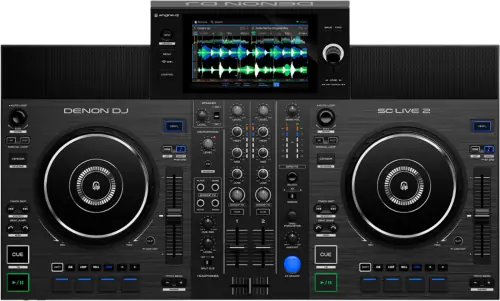
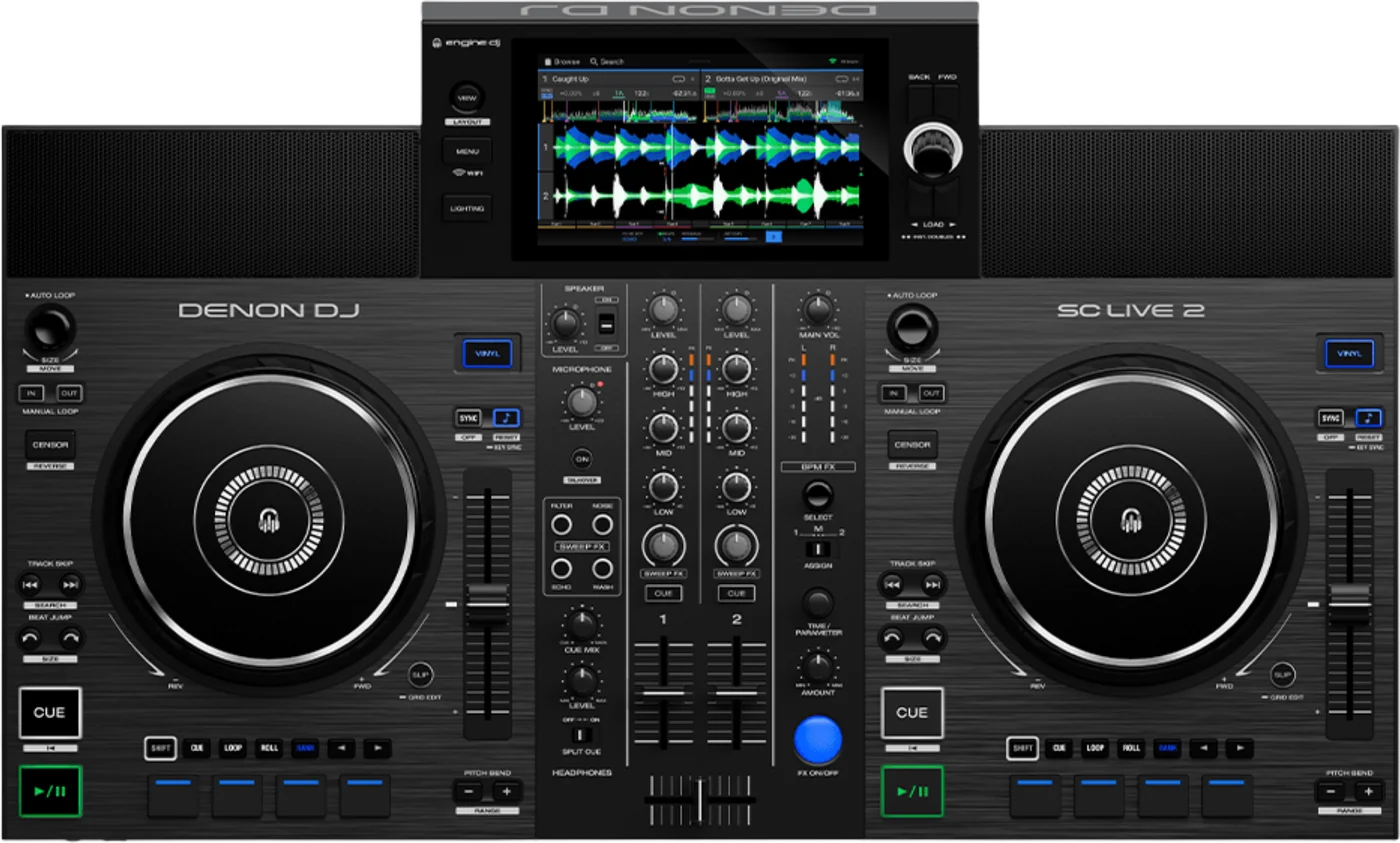
Booth briefing. The SC LIVE 2 is Denon's two channel standalone with speakers built in: a 7 inch screen, two USB ports and an SD slot, and no computer needed in the signal path. It reads exFAT and FAT32 drives. Monitoring is through the internal speakers and the headphone output; there is no separate booth output on this unit, and the microphone input is a single jack socket.
When it goes wrong: Denon USB format, exFAT or FAT32 The Denon will not read the drive
Fast Lane
The five things that decide your gig
The five things on the SC LIVE 2 that change what happens next, if you are reading this in the booth. All five are explained in full further down this page.
There is no booth output. The speakers and the headphones are all you get.
Its specification block lists two balanced XLR main outputs, an unbalanced RCA main pair and two headphone outputs, and no booth output of any kind. Neither the guide nor Denon's own product page lists one, so there is no separate monitor feed on either list.
On a stage where the PA is in front of you and pointed away, that is the difference between hearing yourself and not. Plan the monitoring before you accept the room.
A drive that will not mount is a format question, and there is no HFS+ here.
The shared guide that covers all seven Engine OS all-in-ones lists the supported file systems as exFAT, marked recommended, and FAT32. HFS+ appears nowhere in it, unlike the guide covering the SC6000 pair, which grants HFS+ to those two models by name.
A Mac formatted drive is the common case. Check the format before you suspect the drive or the socket.
One microphone input, and it is a jack.
It has a single 6.35 mm microphone input, so an XLR microphone needs an adapter or a cable that ends in a jack.
That is a thing to find out at home rather than when somebody hands you a wireless receiver with an XLR output on it.
Ejecting a drive unloads its tracks from every networked unit, not just this one.
Denon put the condition first: "Make sure none of its tracks are being played on any connected Engine OS media players. Ejecting a device unloads its tracks from all networked media players."
The unit you are standing at will not look busy while it happens.
No Slicer, and the effects live on the screen.
Slicer Mode is marked in the guide as PRIME 4, PRIME 2 or SC LIVE 4 only, so this unit does not have it.
The guide states BPM FX are selectable through the top panel FX buttons and knobs on PRIME 4 and PRIME 4+ only. On this unit the effects are reached from the touchscreen.
If something goes wrong
The USB drive will not mount or shows no tracks
Short answer. The SC LIVE 2 is refusing a file system before it is refusing a drive. It reads exFAT, which Denon mark as recommended, and FAT32, and that is the whole list in the guide that covers it.
Why this happens. The shared guide that covers all seven Engine OS all-in-ones lists the supported file systems as exFAT, marked recommended, and FAT32. HFS+ appears nowhere in it, unlike the guide covering the SC6000 pair, which grants HFS+ to those two models by name. A drive formatted on a Windows machine without a second thought is often NTFS, which is not on the list either.
Fix it now. Try the other USB port or the SD card slot before you assume the drive is at fault. If the format is wrong, reformat to exFAT on another computer and copy the music back on.
Avoid it next time. Format and test on this unit before the gig rather than on whatever Engine OS hardware is nearest, because the range does not read one list.
Taking a drive out safely
Short answer. The SC LIVE 2 has a printed procedure and a condition that reaches past this unit. Make sure none of its tracks are being played on any connected Engine OS media players. Ejecting a device unloads its tracks from all networked media players.
Why the condition matters. Ejecting unloads the tracks from every networked Engine OS unit, so a drive you pull can clear a deck on a machine you are not standing at.
Avoid it next time. Eject before you unplug, every time, including at the end of the set.
What to watch for
What the specification lists, and what it does not
Short answer. The SC LIVE 2 has no booth output. Its specification block lists two balanced XLR main outputs, an unbalanced RCA main pair and two headphone outputs, and no booth output of any kind. Neither the guide nor Denon's own product page lists one, so there is no separate monitor feed on either list.
Why this is the first thing on the page rather than a footnote. A booth output is how a performer hears something other than the room. Without one, monitoring is the internal speakers or the headphones, and the internal speakers are also the thing the audience is listening to. On a small stage that works. In a room where the PA faces away from you, it is the difference between hearing your mix and guessing at it.
What the unit does have. It carries internal speakers, with a Speaker button on the top panel that mutes and unmutes them. So the speakers can be muted and the room fed from the XLR outputs, which is the arrangement most rooms with their own PA will want.
Do this before you accept the booking. Ask what the room provides. If the answer is a PA and no monitor, this unit does not add one.
What belongs to other models in the same guide
Short answer. Two features in the shared guide are described as though they were general and are not, and the SC LIVE 2 has neither. Slicer Mode is marked in the guide as PRIME 4, PRIME 2 or SC LIVE 4 only, so this unit does not have it.
And the effects live on the screen. The guide states BPM FX are selectable through the top panel FX buttons and knobs on PRIME 4 and PRIME 4+ only. On this unit the effects are reached from the touchscreen.
Why this page names absences. One guide covers seven products and prints the differences as brackets at the ends of sentences. A reader working through it will meet Slicer Mode described in full, with the qualifier in brackets, and reasonably assume their unit has it.
What it does have. The same Engine OS library, screen and pad system as the rest of the range, so what you learn here transfers upward.
Compatibility
Which drives and formats it reads
Short answer. exFAT, which Denon mark as recommended, and FAT32. The shared guide that covers all seven Engine OS all-in-ones lists the supported file systems as exFAT, marked recommended, and FAT32. HFS+ appears nowhere in it, unlike the guide covering the SC6000 pair, which grants HFS+ to those two models by name.
What it will play. AAC/M4A, AIF/AIFF, ALAC, FLAC, MP3, MP4, Ogg Vorbis and WAV, with AIF/AIFF and WAV documented at 44.1 to 192 kHz and 16 to 32 bit, and MP3 at 32 to 320 kbps.
Why the HFS+ point is worth stating. A DJ who also uses an SC6000 has one deck that reads a Mac formatted drive and one that does not, and neither says so on screen.
What each slot takes
Short answer. The SC LIVE 2 has two USB ports for drives and an SD card slot, plus a USB port to a computer.
What that means for a library. There is no internal drive bay, so everything you play comes off a stick, a card, or a computer on the USB port.
Why the card slot is worth using. It is a second, separate device that stays in the unit and cannot be knocked out of a socket.
Features explained
The microphone input, and where the signal goes
Short answer. The SC LIVE 2 has a single 6.35 mm microphone input. Its own rear panel section states it, and the inch marks are Denon's: Microphone Input (1/4" / 6.35 mm): Use a standard 1/4" (6.35 mm) cable (not included) to connect a standard dynamic microphone to this input.
The connector is the practical part. A jack rather than an XLR means a wireless receiver, a stage box or a borrowed microphone that ends in XLR needs an adapter. That is a small part and a ruined announcement if it is not in the bag.
Where it goes. Denon print one line: "The audio signals from the microphones are routed directly to the Master/Main Outputs." That is what the guide states and all it states.
Talkover. The unit has a Talkover button, which automatically reduces the volume level of the main mix when you speak into the microphone, with the amount set under Settings and Mic
Note what is different from the four channel unit. The SC LIVE 4 has a second microphone input that shares a switch with its Aux input. This unit has one microphone input and no such switch.
Professional tips
Before you play on one
Sort the monitoring before you say yes to the room. There is no booth output on this unit.
Carry a jack to XLR adapter. The microphone input is a jack and most borrowed microphones are not.
Format to exFAT. There is no HFS+ in this guide.
Put the set on the card as well as the stick. Two USB ports and a card slot, and no internal drive to fall back on.
Learn the effects on the screen. The panel FX buttons belong to the PRIME 4 and the 4+, not to this unit.
Connections and setup
What comes out of the back, and what goes in
Outputs. two balanced XLR main outputs, an unbalanced RCA main pair, and 6.35 mm and 3.5 mm headphone outputs. There is no booth output, which has its own section.
Plus the speakers in the unit. It has internal speakers, with a Speaker button on the top panel that mutes and unmutes them.
Inputs. a single 6.35 mm microphone input.
The physical facts. It has a 7 inch display, 178 mm on the diagonal, and no platter displays, measures 67.8 x 39.1 x 9.9 cm, weighs 4.6 kg and runs on 12 V, 3.0 A DC, centre positive.
Firmware, drivers and manuals
Official downloads and documents
Go to Denon DJ for the files themselves. We link their pages instead of hosting a copy, because a manual copied here is a snapshot of release day and theirs is the one that stays current.
Manuals. Official Denon DJ manual page →
Broken link? Let us know and we'll fix it.
Frequently asked questions
Quick answers
- Does it have a booth output?
- No. Its specification block lists two balanced XLR main outputs, an unbalanced RCA main pair and two headphone outputs, and no booth output of any kind. Neither the guide nor Denon's own product page lists one, so there is no separate monitor feed on either list.
- What can I monitor on?
- The internal speakers or the headphones. There is no separate monitor feed.
- How many microphone inputs does it have?
- One. It has a single 6.35 mm microphone input, so an XLR microphone needs an adapter.
- What file systems does it read?
- exFAT, which Denon mark as recommended, and FAT32. There is no HFS+ anywhere in the guide that covers it.
- What file formats does it play?
- AAC/M4A, AIF/AIFF, ALAC, FLAC, MP3, MP4, Ogg Vorbis and WAV, with AIF/AIFF and WAV documented at 44.1 to 192 kHz and 16 to 32 bit, and MP3 at 32 to 320 kbps.
- What can I put a library on?
- It has two USB ports for drives and an SD card slot, plus a USB port to a computer. There is no internal drive bay.
- Does it have Slicer mode?
- No. Slicer Mode is marked in the guide as PRIME 4, PRIME 2 or SC LIVE 4 only, so this unit does not have it.
- Can I reach the effects without the touchscreen?
- No. The guide states BPM FX are selectable through the top panel FX buttons and knobs on PRIME 4 and PRIME 4+ only. On this unit the effects are reached from the touchscreen.
- How do I take a drive out?
- Make sure none of its tracks are being played on any connected Engine OS media players. Ejecting a device unloads its tracks from all networked media players.
- How is it different from the SC LIVE 4?
- Two channels rather than four, no booth output, one microphone input rather than two, and no Slicer mode. Both have internal speakers and both read the same file systems.
Where this sits in the line
- Static-platter version SC LIVE 4
Related all-in-ones
Playing soon and it is not working?
Start Emergency ModeKeep the Emergency Card
We will email you the printable PDF so it is on your phone before the next dark booth. Occasional notes that save gigs. No spam, unsubscribe in one click.
Registering is free and counts everywhere on Save My Gig. We send a confirmation email first. Your address is stored with Brevo, our email provider. Unsubscribe any time. Privacy
Sources: Denon DJ's shared PRIME 4, 4+, 2, GO, GO+, SC LIVE 4, 2 User Guide version 5.0.0, and Denon DJ's own product and downloads pages, checked 9 September 2026. Specifications theirs, priorities ours.