

T9, the field manual
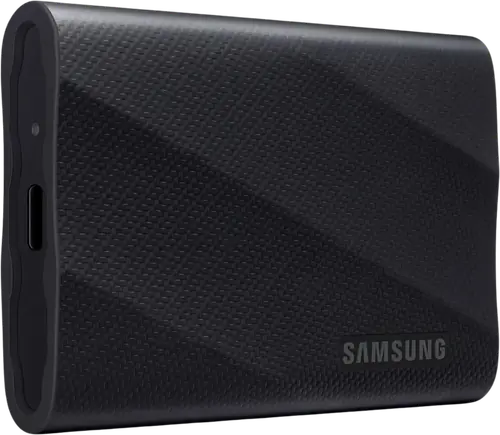
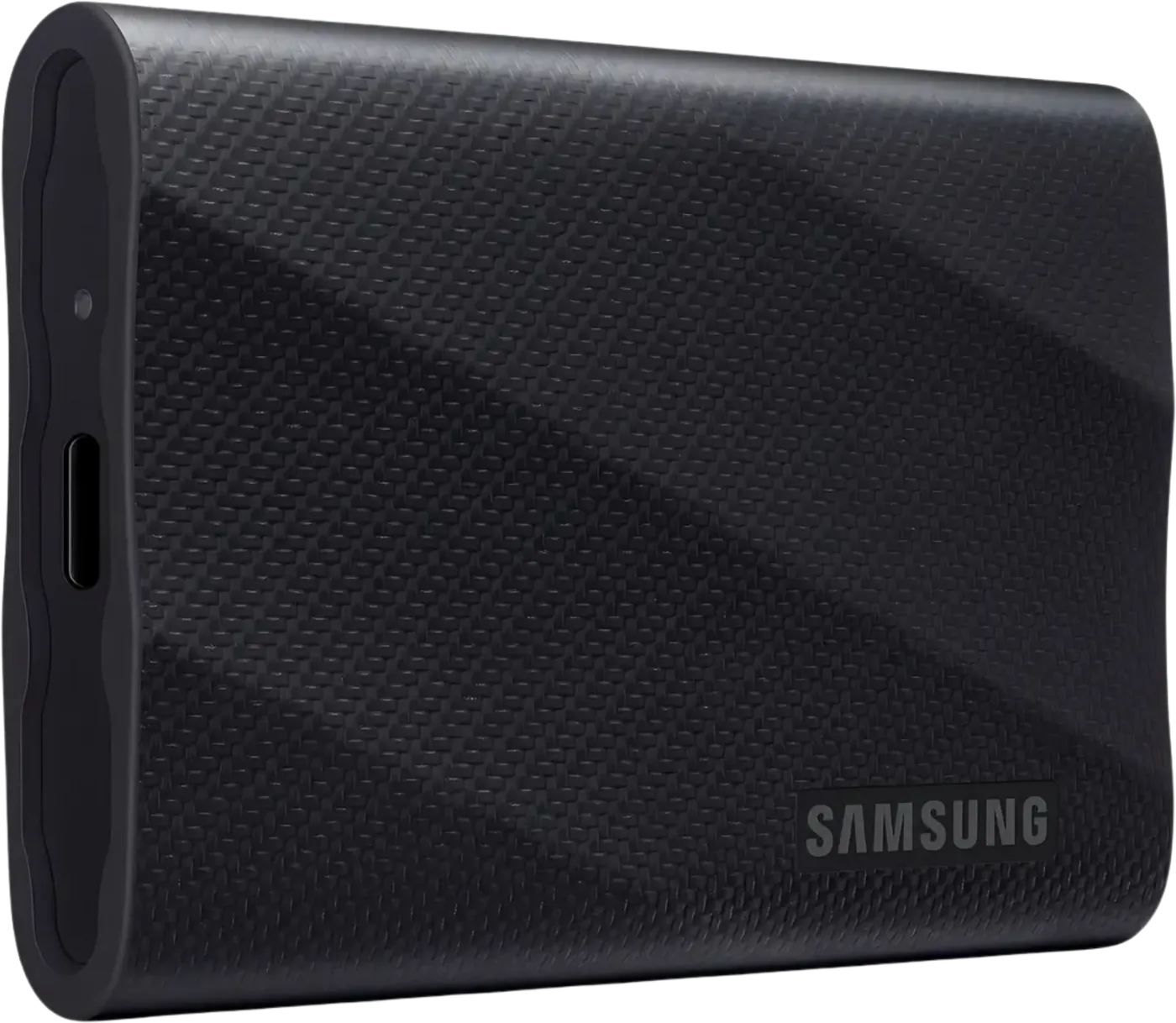
Booth briefing. The fast one, and the booth cannot tell. The Samsung T9 is a USB 3.2 Gen 2x2 drive rated at 2,000 MB/s, launched in October 2023 with a five-year warranty and both cables in the box. That speed needs a 20 Gbps port, which a handful of laptops have and no DJ player does: on a CDJ it is read at the CDJ’s speed, like every other drive. Buy it for a video workstation or a library that exports in minutes rather than an hour; carry it to a gig knowing it behaves like a T7 there, including on the older players that refuse USB 3.2 drives.
Fast Lane
The five things that decide your gig
The five things about the T9 that change what happens next, if you are reading this in the booth. All five are explained in full further down this page.
2,000 MB/s is for a 20 Gbps laptop port. No player has one.
Older players that refuse USB 3.2 drives refuse this one too.
Pioneer DJ staff say older players sometimes have issues with USB 3.1 and 3.2 drives while working with USB 3.0 ones. A faster controller is not a more compatible one.
The C-to-A cable in the box is the one that plays the gig.
The drive is USB-C. Every CDJ and most XDJs are USB-A. Samsung ship both cables; keep the C-to-A one with the drive.
Five years of warranty, three metres of drop, no IP rating.
The warranty is two years longer than the T7 and T7 Shield. The Shield keeps the IP65 rating the T9 does not have.
Password protection locks the player out, not just the thief.
The lock lives in Samsung’s software on a computer. A CDJ has no way to enter a password.
If something goes wrong
The player does not see the drive
Short answer. Four things decide this, and the T9 itself is the fourth. In order: the file system the drive is formatted in (the matrix says what each player reads), the library format you exported (OneLibrary for the newer AlphaTheta units, Device Library for the older ones, explained here), the partition style on an Engine OS unit (MBR, not GPT), and only then the drive.
Why the drive can be the reason. The T9 is a USB 3.2 Gen 2x2 (20 Gbps) drive. Pioneer DJ staff say on their own forum that "not all drives work with all players", that older players sometimes have issues with USB 3.1 and 3.2 drives while working with USB 3.0 ones, and that the cause is the drive's memory controller conflicting with the player's USB host chipset. A drive that a CDJ-3000 reads and a CDJ-2000NXS2 refuses, both formatted correctly, is that conflict and not a fault you can format away.
Fix it now. Try the drive on the other player in the booth. If both refuse it and a pen drive works, play from the pen drive and sort it after the set. If you carry a second drive, that is what it is for. Connecting a drive to a player never deletes what is on it.
Avoid it next time. Test the T9 at home on the oldest player you expect to meet, not the most recent one, and carry a pen drive with the same library alongside it.
rekordbox does not see it, or the export crawls
Short answer. rekordbox sees drives the operating system mounts. If the T9 is not in the export list, macOS or Windows has not mounted it: a locked drive, a cable that carries power and not data, or a hub in between. Plug it straight into the laptop with the cable that came in the box.
Speed. The T9 is rated up to 2,000 MB/s read. That number needs a USB 3.2 Gen 2x2 (20 Gbps) port on the laptop end and says nothing about the player end: every CDJ and XDJ reads the drive at the player's own USB speed, and a set never needs more than that. Buy the speed for the export at home, not for the booth.
What to watch for
Password protection is a studio feature, not a booth one
Short answer. The T9 carries AES 256-bit hardware encryption with password protection, switched on through Samsung’s own software on a computer. The lock lives in software on a computer, and there is no computer inside a CDJ. A T9 locked on the laptop is a drive a player has no way to unlock.
What to do instead. Keep the protected drive and the gig drive as different drives. If one drive has to do both jobs, leave the protection off and accept that the answer to a lost drive is a backup rather than a password.
Compatibility
What the maker names, and what the player makers do not
Short answer. Samsung state the T9 works with Windows, macOS and Android, and backward compatibility with USB 3.2, 3.1, 3.0 and 2.0 ports, per Samsung’s newsroom. No player maker names the T9 as tested with a CDJ, XDJ or Engine OS unit, and this page does not claim one does.
What decides it instead. The file system and the library format, both of which are per player and both of which are on the USB compatibility matrix. A drive the maker says is compatible with macOS is a drive macOS can format; it is not a statement about any player.
The connector question. USB Type-C on the drive. Samsung ship both a C-to-C and a C-to-A cable, so it reaches a USB-A player without an adapter.
Features explained
Capacity, speed and connectors
- Interface
- USB 3.2 Gen 2x2 (20 Gbps)
- Capacities
- 1 TB, 2 TB, 4 TB
- Sequential read
- up to 2,000 MB/s
- Sequential write
- up to 2,000 MB/s (Samsung state up to 1,950 MB/s on the 1 TB model)
- Connector
- USB Type-C
- In the box
- Samsung ship a USB Type-C-to-C and a USB Type-C-to-A cable in the box.
- Durability
- drop resistance to 3 m
- Size
- 88 x 60 x 14 mm
- Weight
- 122 g
- Warranty
- five-year limited warranty
- Encryption
- AES 256-bit hardware encryption
The speeds are Samsung’s ratings over a USB 3.2 Gen 2x2 (20 Gbps) port. On a USB 3.0 or USB 2.0 port, which is what most players and many laptops have, the drive runs at that port’s speed, and a set does not need more.
Professional tips
Decisions to make before the drive goes in the bag
The cable is part of the drive. Samsung ship a USB Type-C-to-C and a USB Type-C-to-A cable in the box. Every CDJ and most XDJs take USB-A, so the C-to-A cable is the one that plays the gig. Keep it with the drive, not in the laptop bag.
Buy two, whatever the capacity. The failure mode of every drive is that one day it stops. Two drives carrying the same library beat one larger drive carrying it alone. How big a gig drive needs to be is a shorter answer than most DJs expect.
Format it yourself, at home. What a new drive ships formatted as is the maker's choice for computers, not for players. Format it to what your players read, copy the music on, and test it on a player before it plays anywhere that matters.
Do not fill it. An SSD near full writes slower and some players choke on a drive with no free space for the library database. Leave room.
Preventive maintenance
Where it can live, and where it cannot
What Samsung publish. Drop resistance to 3 metres in a rubberised body, per Samsung. No water or dust rating.
Why it matters. A gig drive spends most of its life waiting: a glovebox in August, a van in February, a windowsill in the sun. Keep the T9 on you rather than in the vehicle, give it a few minutes indoors before soundcheck if it has been somewhere cold, and replace a gig drive on a schedule rather than on a failure.
Firmware, drivers and manuals
Where the maker keeps the rest
Frequently asked questions
Quick answers
- Will a CDJ read the T9 faster than a T7?
- No. Both are read at the player’s own USB speed. Samsung’s 2,000 MB/s needs a USB 3.2 Gen 2x2 port, which players do not have.
- Then why buy it?
- For the laptop end: a large library exports and backs up in a fraction of the time on a Gen 2x2 port, and it carries a five-year warranty. Those are studio reasons, and honest ones.
- Is it more compatible with older players than the T7?
- Nothing published says so. Pioneer DJ staff describe the older-player problem as a USB 3.1/3.2 controller conflict, which a faster USB 3.2 drive does not escape. Test it.
- Which cable do I need at a CDJ?
- The USB-C-to-A cable Samsung put in the box. The C-to-C one is for the laptop.
Related products
Playing soon and it is not working?
Start Emergency ModeKeep the Emergency Card
We will email you the printable PDF so it is on your phone before the next dark booth. Occasional notes that save gigs. No spam, unsubscribe in one click.
Registering is free and counts everywhere on Save My Gig. We send a confirmation email first. Your address is stored with Brevo, our email provider. Unsubscribe any time. Privacy
Sources: Samsung’s T9 product page and US newsroom announcement, and Pioneer DJ staff answers on the Pioneer DJ forum, read 19 September 2026. Specifications theirs, priorities ours.